Monday, September 04, 2006


Neville Chamberlain in Iraq

(Mother Jones republished Frank Rich's column despite it being part of the NYTimes Select stuff you're supposed to pay for! Shame on them! Here's the column -- judge for yourself how naughty Mother Jones was!)

September 3, 2006
Op-Ed Columnist
Donald Rumsfeld’s Dance With the Nazis
By FRANK RICH

PRESIDENT BUSH came to Washington vowing to be a uniter, not a divider. Well, you win some and you lose some. But there is one member of his administration who has not broken that promise: Donald Rumsfeld. With indefatigable brio, he has long since united Democrats, Republicans, generals and civilians alike in calling for his scalp.

Last week the man who gave us “stuff happens” and “you go to war with the Army you have” outdid himself. In an instantly infamous address to the American Legion, he likened critics of the Iraq debacle to those who “ridiculed or ignored” the rise of the Nazis in the 1930’s and tried to appease Hitler. Such Americans, he said, suffer from a “moral or intellectual confusion” and fail to recognize the “new type of fascism” represented by terrorists. Presumably he was not only describing the usual array of “Defeatocrats” but also the first President Bush, who had already been implicitly tarred as an appeaser by Tony Snow last month for failing to knock out Saddam in 1991.

What made Mr. Rumsfeld’s speech noteworthy wasn’t its toxic effort to impugn the patriotism of administration critics by conflating dissent on Iraq with cut-and-run surrender and incipient treason. That’s old news. No, what made Mr. Rumsfeld’s performance special was the preview it offered of the ambitious propaganda campaign planned between now and Election Day. An on-the-ropes White House plans to stop at nothing when rewriting its record of defeat (not to be confused with defeatism) in a war that has now lasted longer than America’s fight against the actual Nazis in World War II.

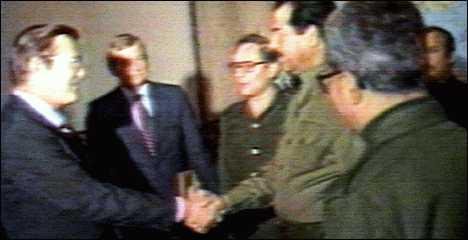
Here’s how brazen Mr. Rumsfeld was when he invoked Hitler’s appeasers to score his cheap points: Since Hitler was photographed warmly shaking Neville Chamberlain’s hand at Munich in 1938, the only image that comes close to matching it in epochal obsequiousness is the December 1983 photograph of Mr. Rumsfeld himself in Baghdad, warmly shaking the hand of Saddam Hussein in full fascist regalia. Is the defense secretary so self-deluded that he thought no one would remember a picture so easily Googled on the Web? Or worse, is he just too shameless to care?

Mr. Rumsfeld didn’t go to Baghdad in 1983 to tour the museum. Then a private citizen, he had been dispatched as an emissary by the Reagan administration, which sought to align itself with Iraq in the Iran-Iraq war. Saddam was already a notorious thug. Well before Mr. Rumsfeld’s trip, Amnesty International had reported the dictator’s use of torture — “beating, burning, sexual abuse and the infliction of electric shocks” — on hundreds of political prisoners. Dozens more had been summarily executed or had “disappeared.” American intelligence agencies knew that Saddam had used chemical weapons to gas both Iraqi Kurds and Iranians.

According to declassified State Department memos detailing Mr. Rumsfeld’s Baghdad meetings, the American visitor never raised the subject of these crimes with his host. (Mr. Rumsfeld has since claimed otherwise, but that is not supported by the documents, which can be viewed online at George Washington University’s National Security Archive.) Within a year of his visit, the American mission was accomplished: Iraq and the United States resumed diplomatic relations for the first time since Iraq had severed them in 1967 in protest of American backing of Israel in the Six-Day War.

In his speech last week, Mr. Rumsfeld paraphrased Winston Churchill: Appeasing tyrants is “a bit like feeding a crocodile, hoping it would eat you last.” He can quote Churchill all he wants, but if he wants to self-righteously use that argument to smear others, the record shows that Mr. Rumsfeld cozied up to the crocodile of Baghdad as smarmily as anyone. To borrow the defense secretary’s own formulation, he suffers from moral confusion about Saddam.

Mr. Rumsfeld also suffers from intellectual confusion about terrorism. He might not have appeased Al Qaeda but he certainly enabled it. Like Chamberlain, he didn’t recognize the severity of the looming threat until it was too late. Had he done so, maybe his boss would not have blown off intelligence about imminent Qaeda attacks while on siesta in Crawford.

For further proof, read the address Mr. Rumsfeld gave to Pentagon workers on Sept. 10, 2001 — a policy manifesto he regarded as sufficiently important, James Bamford reminds us in his book “A Pretext to War,” that it was disseminated to the press. “The topic today is an adversary that poses a threat, a serious threat, to the security of the United States of America” is how the defense secretary began. He then went on to explain that this adversary “crushes new ideas” with “brutal consistency” and “disrupts the defense of the United States.” It is a foe “more subtle and implacable” than the former Soviet Union, he continued, stronger and larger and “closer to home” than “the last decrepit dictators of the world.”

And who might this ominous enemy be? Of that, Mr. Rumsfeld was as certain as he would later be about troop strength in Iraq: “the Pentagon bureaucracy.” In love with the sound of his own voice, he blathered on for almost 4,000 words while Mohamed Atta and the 18 other hijackers fanned out to American airports.

Three months later, Mr. Rumsfeld would still be asleep at the switch, as his war command refused to heed the urgent request by American officers on the ground for the additional troops needed to capture Osama bin Laden when he was cornered in Tora Bora. What would follow in Iraq was also more Chamberlain than Churchill. By failing to secure and rebuild the country after the invasion, he created a terrorist haven where none had been before.

That last story is seeping out in ever more incriminating detail, thanks to well-sourced chronicles like “Fiasco,” “Cobra II” and “Blood Money,” T. Christian Miller’s new account of the billions of dollars squandered and stolen in Iraq reconstruction. Still, Americans have notoriously short memories. The White House hopes that by Election Day it can induce amnesia about its failures in the Middle East as deftly as Mr. Rumsfeld (with an assist from John Mark Karr) helped upstage first-anniversary remembrances of Katrina.

One obstacle is that White House allies, not just Democrats, are sounding the alarm about Iraq. In recent weeks, prominent conservatives, some still war supporters and some not, have steadily broached the dread word Vietnam: Chuck Hagel, William F. Buckley Jr. and the columnists Rich Lowry and Max Boot. A George Will column critical of the war so rattled the White House that it had a flunky release a public 2,400-word response notable for its incoherence.

If even some conservatives are making accurate analogies between Vietnam and Iraq, one way for the administration to drown them out is to step up false historical analogies of its own, like Mr. Rumsfeld’s. In the past the administration has been big on comparisons between Iraq and the American Revolution — the defense secretary once likened “the snows of Valley Forge” to “the sandstorms of central Iraq” — but lately the White House vogue has been for “Islamo-fascism,” which it sees as another rhetorical means to retrofit Iraq to the more salable template of World War II.

“Islamo-fascism” certainly sounds more impressive than such tired buzzwords as “Plan for Victory” or “Stay the Course.” And it serves as a handy substitute for “As the Iraqis stand up, we’ll stand down.” That slogan had to be retired abruptly last month after The New York Times reported that violence in Baghdad has statistically increased rather than decreased as American troops handed over responsibilities to Iraqis. Yet the term “Islamo-fascists,” like the bygone “evildoers,” is less telling as a description of the enemy than as a window into the administration’s continued confusion about exactly who the enemy is. As the writer Katha Pollitt asks in The Nation, “Who are the ‘Islamo-fascists’ in Saudi Arabia — the current regime or its religious-fanatical opponents?”

Next up is the parade of presidential speeches culminating in what The Washington Post describes as “a whirlwind tour of the Sept. 11 attack sites”: All Fascism All the Time. In his opening salvo, delivered on Thursday to the same American Legion convention that cheered Mr. Rumsfeld, Mr. Bush worked in the Nazis and Communists and compared battles in Iraq to Omaha Beach and Guadalcanal. He once more interchanged the terrorists who struck the World Trade Center with car bombers in Baghdad, calling them all part of the same epic “ideological struggle of the 21st century.” One more drop in the polls, and he may yet rebrand this mess War of the Worlds.

“Iraq is not overwhelmed by foreign terrorists,” said the congressman John Murtha in succinct rebuttal to the president’s speech. “It is overwhelmed by Iraqis fighting Iraqis.” And with Americans caught in the middle. If we owe anything to those who died on 9/11, it is that we not forget how the administration diverted our blood and treasure from the battle against bin Laden and other stateless Islamic terrorists, fascist or whatever, to this quagmire in a country that did not attack us on 9/11. The number of American dead in Iraq — now more than 2,600 — is inexorably approaching the death toll of that Tuesday morning five years ago.

Thursday, August 31, 2006


I'm sure this will get plenty of play, but I wanted to point out that yesterday's "Helen, Sweetheart of the Internet" joke is tomorrow's news story.

FORT WORTH, Texas Aug 30, 2006 (AP)
— RadioShack Corp. followed through on its announced plans to cut about 400 jobs, but the electronics retailer has been forced on the defensive about its method of notifying laid-off employees by e-mail.

Employees at the Fort Worth headquarters received an e-mail Tuesday morning telling them they were being dismissed immediately.

"The work force reduction notification is currently in progress," the notice stated. "Unfortunately your position is one that has been eliminated."

Wednesday, August 30, 2006


Wit from the Bench

I was researching Supreme Court cases regarding the rights of students for an upcoming series on the Constitution when I came across this excerpt from an opinion written by Justice Stevens in the 1981 case of Widmar v. Vincent. In that case, the court ruled that the University of Missouri was wrong to ban the use of campus facilities by religious groups, saying that while the university had the right to set rules, they couldn't single out religion as a banned content area. In his concurring opinion, Stevens sought to emphasize that requiring fairness was not a requirement that schools give up any attempt at critical judgment:

Because every university's resources are limited, an educational institution must routinely make decisions concerning the use of the time and space that is available for extracurricular activities. In my judgment, it is both necessary and appropriate for those decisions to evaluate the content of a proposed student activity.

I should think it obvious, for example, that, if two groups of 25 students requested the use of a room at a particular time -- one to view Mickey Mouse cartoons and the other to rehearse an amateur performance of Hamlet -- the First Amendment would not require that the room be reserved for the group that submitted its application first.

Nor do I see why a university should have to establish a "compelling state interest" to defend its decision to permit one group to use the facility and not the other. In my opinion, a university should be allowed to decide for itself whether a program that illuminates the genius of Walt Disney should be given precedence over one that may duplicate material adequately covered in the classroom.

Tuesday, August 29, 2006


Drawing Conclusions goes light on the politics this week with a look at Pluto's demotion through the eyes of the Toronto Star's Dave "Andy" Anderson and the Detroit News's Henry Payne.

Meanwhile, Nellie Bly takes the anniversary of Katrina as an occasion to do a little reflecting on how tight deadlines and bogus numbers intersect in the news business.

http://www.nelliebly.org

Sunday, August 27, 2006


Bogus pop-up of the day

Yeah, I think I saw these girls the last time I drove through Fort Edward.
They had the spreader loaded and they were headed for the hayfield.
(Yes, I sometimes lie about my exact location when registering.)

Saturday, August 26, 2006


NYTimes exclusive: Water is a drowning hazard! (and math is hard!)

HONOLULU, Aug. 25 — The blue waters surrounding the Hawaiian Islands may be irresistible, to tourists and residents alike, but swimming there — or surfing, snorkeling, diving or kayaking — can be deadly. And not just for the reason that seizes the imagination.

What? The reason that seizes my imagination is that the ocean has a pretty high water content, not to mention rip tides and such.

While it is the infrequent shark attacks that make the headlines, (Oh, right. Jaws. Okay, carry on.) drowning claims far more lives in Hawaii, where coastlines of sand, coral reef and lava rock create shorebreaks and currents that cause many swimmers to encounter peril entirely unexpected. Indeed, most of the victims are adults who thought they were good swimmers.

(Okay, I can live with "many," though "entirely unexpected" gives me a slight case of the collywobbles. But could we get a source for that last statistic -- drowning rates among adults who self-rated their swimming ability as "good"?)

“The waters at many beaches are deceptively beautiful,” said Dr. Chiyome Fukino, the state health director. “Even if you know how to swim, if you get into nasty surf, if you’re ill or injured, your chances of drowning are increased.”

Seventy-one people drowned in Hawaii in 2004, 58 of them in the ocean. The toll was the highest here in 15 years, but then was eclipsed by last year’s total of 77.

It is not just the millions of tourists who are at risk. Nearly half of all drowning victims are residents, a statistic that gives Hawaii an exceptionally high per-capita rate. The state’s Department of Health reports that from 1999 to 2003, 9.7 people drowned for every 100,000 residents, more than double the national rate of 4.7. That made the state’s rate for the period second only to that of Alaska, where fishing accidents account for a large share of drownings.

Let's go back to the "half of them are residents" part. Is she saying that the 9.7 per 100,000 stat is based only on dead residents? If so, why doesn't it say "9.7 Hawaiians drowned ... "

A look at Hawaii's Dept of Health suggests that she's counting the tourists despite having just excluded them. I couldn't find the exact figures she's citing (and I do have to get back to work on my paying job), but here's what a quick search turned up:

G. Drowning Deaths

Current status and trends in Hawai`i

Drownings are the second leading cause of unintentional injury death. Each year in Hawai`i, there are nearly 50 drownings and over 100 water-related hospitalizations occurring mainly from activities in the ocean and pools. Hawai`i has more ocean-related drownings and injuries leading to death and disability per square mile than any other state. Nearly half of all ocean-related drownings and hospitalized injuries occur to non-residents, therefore de facto population estimates yield a more accurate injury rate.

Healthy Hawai`i 2000
Objective Baseline (1990)47 and current data

9.H Reduce drowning deaths to Drowning deaths 1990 1991 1992 1993 1994
no more than 3.0 per 100,000 among state residents 4.4 2.5 3.2 3.4 3.4
people. Drowning deaths 5.3 3.6 3.8 4.3 5.3
inde facto population

NOTE: Hawai`i's baseline for this objective is not resident population-based, as it includes visitors. Therefore, it can not be compared to the national objective.
47Hawai`i Department of Health Status Monitoring, Vital Statistics data, special tabulation.

She goes on to talk about the videos they're showing tourists to warn them about the dangers of the ocean -- pretty much recycling a story that ran two months ago in the Honolulu Advertiser, but not ripping it off. Just not improving on it much. The difference being that the Advertiser ran some fact boxes that, while more current than the ten-year-old figures in this DOH report, were closer to this rate than the 9.7 quoted by the NYTimes writer.

And the Honolulu reporter didn't automatically assume that, when readers think of hazards in the ocean, they imagine Jaws.

Tuesday, August 22, 2006


This job description is a lot funnier if you understand journalism pay scales

Company: Democrat and Chronicle
Position:
Business reporter
Location:
Rochester, New York
Job Status: Full-time
Salary: Not Specified
Ad Expires:
September 22, 2006
Job ID: 672529
Description:
We’re seeking an enterprising business reporter to cover fast-developing medical tech and biotech industry, including Bausch & Lomb, one of the world's largest eye-care companies. The reporter will think new media, eager to break news on our website and bring a flair for good writing to Page 1A and the Sunday and daily Business sections of our newspaper (160,290 daily and 219,660 Sunday). On the multimedia front, this reporter should be prepared to do podcasts, collect audio interviews, work with videographers and appear on television with the local ABC affiliate as needed. Interested? Please contact Neill Borowski, managing editor, the Democrat and Chronicle, Rochester, NY. Email jobs@democratandchronicle.com and nborowsk@democratandchronicle.com.

(cartoon is Between Friends by Sandra Bell-Lundy)

Friday, August 18, 2006


Here we go again.

School is just around the corner and I've got mountains of stuff to get done in the next two weeks. This year's serial combines mythology and astronomy and, unfortunately, I don't really know much about astronomy except what I learned in Earth Science ... well, so long ago that some of the stars have moved since then. I'm way out of my comfort zone with this stuff, but it will be pretty cool when I'm done. (Fortunately, I have the help of a friend. Unfortunately, he's out of the country.)

Which either means I won't be updating the blog much or else I'll be posting a lot, and so, by checking in here, you'll be able to tell whether I'm hunkered down or blissfully avoiding what must be done.

The illustration here is a favorite Peanuts simply because so many NIE programs base their entire educational approach on goofy fun stuff of no real value in the classroom. A classic request on the NIE listserv is "Does anyone have the directions for making a pressman's hat?" While I have nothing against making hats, I wish that request was at least equalled, if not outnumbered by, "Does anyone have any really good First Amendment resources?"

In any case, I'll be in the office much of the weekend and I won't be folding hats.

Sunday, August 13, 2006


No pida, no diga

(an Ecuadorian pamphlet my co-worker, Peggy, came across. A translation I cobbled from Babelfish.)

Thursday, August 10, 2006


Arthur Lee died the other day. That won't matter to very many people, but it will certainly be noticed by those who knew who he was.

About ... gee ... was it 20 years ago? More or less. Anyway, I was at a college reunion and my buddy Charlie came by, even though it wasn't his year, and we played a little guitar music together. We played "Signed DC" and "A House Is Not A Motel" and then were piddling around with a kind of funny one called "Live and Let Live."

I mentioned that, since I'd left school, I hadn't run into very many people who had even heard of Love, much less knew any of their songs. And Charlie off-handedly remarked, "Well, they were a musicians' band." And I realized it was true -- the people who I associated with the group were almost all musicians, or very close to the music scene.

The thing that was different with Love was that a lot of the bands that are "musicians' bands" are so esoteric that nobody would want to listen to them except to marvel over (and steal) certain licks. But Love was incredibly listenable music, with nice, accessible instrumentation (easier to listen to than to play) and a kind of baroque lyrical sense that Jim Morrison could have learned from. And apparently did.

Funny thing: One of the obits I read quoted a line from "The Red Telephone" as an example of Arthur Lee's genius. The line -- "They're locking them up today. They're throwing away the key. I wonder who it will be tomorrow, you or me? (We're all normal and we want our freedom!)" -- was often quoted back then. But the line was taken from "Marat/Sade." (The lyrics linked here attribute the song to Bryan Maclean, but it's by Lee. Except, y'know, for the line everybody quotes.)

And speaking of locking people up and throwing away the key, for awhile back in those days, I lived next door to a guy who was on a "perma-trip." Steve had dropped acid one time and never really came down again. It had been awhile and, though he was from Washington, DC, he was in South Bend at the moment because his buddies took turns watching out for him, and a couple of them were living out there. He wasn't at all trippy or goofy -- actually, he was very quiet and very nice, but you couldn't really hold a conversation with him. I don't think he was hallucinating. He'd just completely lost his ability to focus. He'd get various shelf-stocking sorts of jobs but he couldn't hold it together and he'd just kind of not work, and either he'd get fired or he'd stop showing up.

But one thing he could still do was play guitar, and he could play every song Love recorded, really well. He was a human jukebox, and there are several Love songs that still remind me of Steve, sitting up in his room playing. He went back to DC after a couple of months and I have no idea what happened to him. I kind of hope someone a little more grounded than his buddies eventually took over his care and feeding.

For that matter, I wish someone more grounded had been able to take over Arthur Lee's care and feeding, because he certainly put himself through some unnecessary things. One of those obits where you're sorry he's dead, but you're also kind of surprised he was still alive.

Anyway, lots of memories and associations, some sublime, some ridiculous. I don't know why this band wasn't more popular. But if you read the obit linked to Lee's name at the beginning, you'll see that a lot of later-to-be-popular bands were listening to him.

Wednesday, August 09, 2006


Bear in Hammock video -- A public service

Ronnie writes: "You know, Mike, I think that forevermore I shall think of incredibly stupid, inane, vapid media fluff pieces as "bear in a hammock" stories."

Especially if you were alone in a hotel with no Internet access and this clip, playing over and over on the news. Admittedly without the annoying soundtrack.

Or the potential bruises of this poor bruin's endlessly replayed adventure.

Tuesday, August 08, 2006


This week in "Drawing Conclusions," Dr. C. Rice gets skewered by the pens of Robert Ariail and Etta Hulme.

And on a lighter, but historically interesting, note, Nellie Bly looks into the significance of Warren Moon's induction into the Pro Football Hall of Fame.

Clueless in cyberspace

I liked this "Monty" strip that ran last week, but I'm not so sure about this article from C/Net news. It seems that, when AOL coughed up the search records of its customers recently, it was possible to piece together what various (anonymous) individuals have been searching for on AOL's own search engine.

Now, granted that AOL users don't have a reputation for being cybersavvy -- and if you eliminate the ones who would have used Google or even Yahoo! as their search engine of choice, you're not really providing a cross-section of the surfing public.

But still. The topics are amusing or depressing or alarming, yes, but the search terms ... do these people think the Internet is a Magic Eight Ball?

Nonsense. The Internet is not a Magic Eight Ball. It's a series of tubes.

Sunday, August 06, 2006


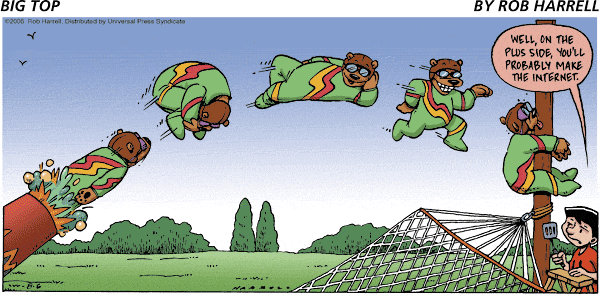
Or nearly so. Rob Harrell's Big Top shows the potential for this newest of X-sports. Hey, if poker and hot-dog eating can be sports, I see no objection to this!

Friday, August 04, 2006


My friend Ronnie sent me this Op-Ed piece from the NYTimes. It's by a guy who found himself on a commercial jet with a Marine escorting a comrade-in-arms to Arlington. Very moving, and from an unusual source -- an anti-hunger activist whom I suspect is embodying the notion of putting politics aside and respecting love and sacrifice.

It came at an opportune time to set my wheels rolling. Last weekend, I went up to Star Lake to help my aunt and her brother shut down the family home there. My mother has moved to the city, not because she doesn't like being in the middle of the Adirondack forest but because it's just time for her to be a little closer to services. Driving 40 miles for this and 50 miles for that becomes a burden, no matter how glorious the surroundings.

We moved there 50 years ago this coming Labor Day and it will always be home to me, though, in fact, I only lived there about 10 years -- from second grade until I left for college. But I'd go back at least once a year, no matter where I was living, and I moved back East nearly 20 years ago, just to be near.

It was hard to know that I wouldn't be going back again except for very important occasions, most likely involving my old buddy Digger, who took over the family mortuary. (And, yes, everyone still calls him "Digger.") In fact, the next-to-last thing I did on the way out of town was to stop off and see my best friend from those days, Bill. And I said, "Oh, I'll be back. I have a piece of property up here, you know." He was surprised until I told him where it was, then he chuckled. "Yeah, I've got some property like that, too," he said.

The last thing I did was to stop by that small piece of property, where my Dad and little brother are.

Anyway, this picture isn't from that particular corner of Star Lake, but from Newcomb, another Adirondack hamlet which, hard as it is to believe, is even smaller and more remote. Newcomb Central School typically graduates classes of 3 or 4 students, though in one recent year they had a senior class of 7.

I was up there a year and a half ago just before Veteran's Day, talking to the high school kids about political cartoons. At noon, we went down to the cafeteria and half the town was in there for a Veteran's Day program, complete with music and lunch for all the area vets. The elementary school kids -- all two dozen or so -- sang the various songs of the branches, and, when they'd sing a song, the veterans of that branch would stand. Most were older men, grandfathers and perhaps great-grandfathers of the singers, the younger vets being off at work, probably an hour away, jobs being scarce in the woods. But others were not related to any of the kids; they were there because they'd been invited. It was a community event.

It was a very simple ceremony but one of the most moving I've ever attended, because it was so personal -- everyone there knew everyone else. And they all grew up, as we did in Star Lake, with a type of patriotism that truly was love of country. When the country calls, you go. And you can argue politics at the bar until closing time, but that is another topic. Young men serve.

When I was in college, I was keenly aware of how little my classmates there understood this, that they didn't see the divide, the duality, that I operated under. I opposed the war, but my buddies, my friends, were there, in Vietnam and mostly out in the field.

I wasn't conflicted in the least by that. Politics was here. Service was there. Maybe it's like when you offer some homeless person a little help, without agonizing over whether it's going to victimize him or let him get drunk again or keep him dependent -- you just help him because he needs help, and you can theorize about it in another venue, another time. When it's time to help out, that's what you do.

If you can't see the little orange blobs in the photo above, click on it and it will come up larger. This is the cemetery at tiny little Newcomb, and every one of those little orange blobs is a Semper Fi flag, on the grave of some country boy who put down his deer rifle and picked up an M-1 or an M-16 or whatever tool they handed him. Most of those country boys went off and did what they were asked to do, and then came home and, like John Stark or Cincinnatus, picked up the reins and got back to work, God bless them.

God bless them.

Tuesday, August 01, 2006


This week, "Drawing Conclusions" looks at civilian casualties in Lebanon through the eyes and pens of Ann Telnaes and Kal. It's really one of the better pairings of panels we've had.

And Nellie Bly travels to the Democratic Republic of Congo to report on the elections.

A bonus link: While I was looking for updated casualty figures for "Drawing Conclusions," I stumbled across this. Simple but effective.

Monday, July 31, 2006


I was thinking about Jerry Bittle the other day. Jerry was one of those friends that you meet on-line and think that some day you'll get together and have a beer and talk deep into the night. That actually happened to me with an on-line buddy -- we were up until nearly 4 a.m., laughing and talking and finding out that we got along just as well in person as on-line.

It didn't happen with Jerry because, before we could get together for those beers, he took a vacation to Central America and somehow had a heart attack while he was scuba diving.

And he left behind a wife and a couple of daughters and far more grief than my losing out on a night of beer and giggles.

But there is still that frustration -- He was working on a new strip, "Shirley and Son," about a divorced family. It was the most compassionate, wonderful, hilarious strip I've ever seen -- absolutely one of a kind. Dammit, I wanted to see how it came out. And I'll bet he did, too.

At the end, in the story arc Jerry was working on before his vacation, Shirley was starting to date, and I told Jerry I was about to go on a date from one of those on-line dating services. Her pics on the Web site looked good, I said, but I was a little concerned because she was a graphic artist. He wrote back that he wanted to hear all about my "Photoshopped blind date" and I meant to tell him all about it, but put it off. And ... well, then it was too late.

It certainly wouldn't have mattered in the grand scheme of things for him to have known that she invited her entire family along on the date, but he certainly would have gotten a huge laugh out of it. And I felt bad that I could have told him, but put it off because, after all, there's always tomorrow.

Jerry's bread-and-butter strip, "Geech," was a genius piece of timing. It was like the Bob Newhart Show -- the real one -- where you knew, as soon as Bob said, "I just want a quiet evening with no interruptions," that Howard was going to come through the door -- you knew it, but you laughed because it was like being in on the joke.

Geech was like that -- yes, predictable, but that was part of the fun. Rabbit would never go to Artie's for dinner. Ruby would never get a date. And the bathrooms at the gas station would never, ever get cleaned.

But with "Shirley and Son," he was reaching beyond brilliance. How he could be so knowing and compassionate without being divorced was a mystery to me. But he said he listened to his friends. Jerry Bittle was one hell of a listener.

I have a couple of missing friends who I wish I could have one more email exchange with, even if we never did get to drink those in-person beers. Jerry Bittle is absolutely the name at the top of that list.

By the way, his stuff is still available on-line here and here.

Thursday, July 27, 2006


Back in June, I wrote about the inanity of network news, particularly the morning shows, which, at the moment, were endlessly replaying footage of a bear trying to climb into a hammock.

It may surprise you to know that Stephen Colbert can be even more incisive on the topic. I found this on Arianna Huffington's Web site, which in turn got it from Atrios.

Wednesday, July 26, 2006


This week, Drawing Conclusions looks at the Lebanese crisis through the eyes of Israeli cartoonist Kichka and Lebanese cartoonist Stavro.

Meanwhile, Nellie Bly looks at "signing statements." Turns out W didn't invent them, he just perfected them to the point where they became a crisis. I would urge you to check the fine print at the bottom of the feature and take a look at the actual ABA report -- fascinating stuff.

http://www.nelliebly.org

Tuesday, July 25, 2006


Hope none of their parents are attorneys

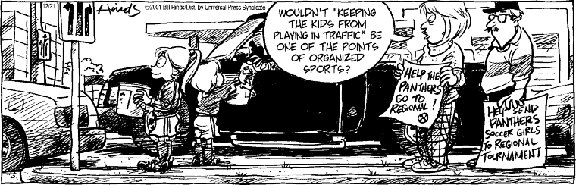
This is a very early strip from "Cleats," which is one of my favorites. Bill Hinds, the artist-half of "Tank McNamara" and creator of "Buzz Beamer," a strip in Sports Illustrated Jr., is artist and writer on this one, which is about kids in rec sports. (A very early strip indeed, come to think of it. Visit the Cleats site for a look at how a strip evolves -- or is intelligently redesigned -- over five years or so.)

But this particular strip was the one that made me a Cleats fan -- it touched on an exposed nerve.

I keep waiting for some town attorney to pipe up at a meeting some time and say, "Do you know how much trouble we'd be in, if some kid got hurt doing this, and we issued the permit for it?"

And yet every summer, you've got the sports teams out at intersections in towns that aren't nearly as small as they used to be, panhandling for spare change from passing cars. Granted, the kids aren't often this young, but it's still an awfully foolish and annoying thing to do.

I don't have the same feeling about "boot drives," where the local volunteer fire department asks for contributions. I figure, if I'm ever driving through that town and end up in a ditch, those are the guys who will come get me out -- either as firefighters if it's serious or, if it's not, just as friendly guys who happened to come by.

But it's been a long time since I've had the kind of travel emergency that required me to attend a rec league game.

I also have no problem with the kids jumping up and down on street corners, waving signs beckoning me into the car wash. That's my choice, and if I've got a couple of bucks and dusty car, I'll succumb once in awhile.

But that's a far cry from "aggressive panhandling," which is what they call it when someone without a permit starts walking up to cars at stoplights and asking for change.

I believe in youth sports. But dodging traffic shouldn't be one of them.

Sunday, July 23, 2006


Chuck Perrin, who runs a jazz club in San Diego, is a vestige of the old folk days in college. He was two years ahead of me and already famous when I arrived -- He'd fronted a major campus rock band and then opened a coffeehouse to showcase the emerging folk scene. He also acted in plays on campus, did some dj'ing on the campus radio station and ran a quixotic campaign for Student Body President. This was a campus of only 8,000 undergraduates, so it didn't take much to become well-known and any two or three of those would probably have done it.

By the time he left, though, he knew who I was, and when I put together a campus folk reunion in 1994, he came along and did a dynamite set. We revisited the idea last summer, only instead of being formal and having microphones and an actual venue, we just went to the house of one of the guys who still lived in town. That's Chuck playing, and the young person with pigtails in the foreground is his daughter, Asa.

It sure was interesting to be in a group of people who knew what they were listening to, as they each got up and took a turn on the folding chair, but let's not be age-snobs about it. Asa and the handful of other folkie offspring at the affair weren't the only people under 50 who showed interest in the music.

The night before, we'd gathered at a small bar near campus, mostly as a place we could all find as we wandered in from New York and California and Chicago and other places, and that, with college over for the summer, wouldn't be busy. The people who wanted to chat stayed upstairs and those who wanted to jam went downstairs to a very dank and barely-finished basement where there were some long folding tables and folding chairs. The thing went on until about midnight and we started peeling off to our various hotels and buddy-housing.

The next day, it turned out that those who had left at midnight were in fine shape and those who hadn't were in rough shape indeed, because, just as things were breaking up, a bunch of college kids had come into the place, heard the music and started buying drinks and making requests. What surprised the old geezers with the guitars was that these youngsters had a pretty good grasp of the Buffalo Springfield sort of era and were asking for appropriate, excellent songs that they maybe hadn't played in 30 or 40 years. But with a dozen musicians, there was somebody who would say, "Yeah, yeah ... I've got it ... um ... " and lead off, and the rest would follow. And on they went until the barowner had to throw them out so he could close.

They told the kids this was our "anti-reunion" -- a gathering not by class year but by who you want to hang out with, and the kids agreed that this made a whole lot more sense.

Or, as Chuck had remarked back in 1994, "My class reunion is next summer, but these are the people I want to see!"

It was a great weekend of music, but it was also a great weekend of hanging out with people who shared some basic beliefs about what you ought to do with your life. It wasn't an issue of hair and lifestyle so much as the consciousness with which everybody is still working, and the number of them who are making the world a better place through their efforts -- teaching or practicing medicine or practicing law with some idea of right outcomes rather than "victories."

There are good people out there, and they don't all dress in ways that make them easy to pick out and line up on this side or that. And they aren't all 50 or 60 years old, either. Still, there are days when it feels like they aren't there, and it's good to be able to point to a moment that reminds you they really are.

Anyway, the reason Chuck is on my mind is that I discovered a new Web toy this weekend -- Pandora Internet Radio, which allows you to set up your own "stations" by choosing an artist as a starting point. The "radio station" then selects musically similar pieces, and you can correct it as it goes along by giving each song a thumbs-up or thumbs-down. You can also add artists, and, while I was fooling around with it, I typed in "Chuck Perrin" and damned if they didn't know who he was.

And now you do, too.

Pandora is a lot of fun and it's free. If you've got any kind of fast connection, go play with it. And if you have slow connections, go to Chuck's site, particularly if you like acoustic jazzy kind of thoughtful music, because he's got a bunch of MP3s you can download and then playback at your leisure.

Friday, July 21, 2006


Just a few minor edits ...

David Horsey ran this cartoon in April, 2002.
It doesn't need much updating.

Tuesday, July 18, 2006


Given the state of world affairs, it shouldn't surprise anyone that both "Drawing Conclusions" and "Around the World with Nellie Bly" are covering Lebanon this week.

"Drawing Conclusions" offers a pair of cartoons by Sargent and Carlson that are both pretty funny, given the seriousness of the situation, and which come at it from very different perspectives.

And Nellie simply recaps 4,000 years of Lebanese history in 400 words. Another day at the office for our Nell.

http://www.nelliebly.org

Hot Mike!

No, no, not a reference to the guy in the picture -- though that skinny, brown-haired 32-year-old should not be overlooked despite the ciggie -- but to the implement of destruction in front of him.

All microphones should be considered "on." Don't rely on the red light. Don't say anything in the studio that you wouldn't want to go out over the air.

That said, there are hot mike stories and there are hot mike non-stories, and, as the Huffington Blog's Eat The Press page notes, the Bush hot mike event was a non-story. He didn't reveal any state secrets, and the fact that he used a scatalogical term for "stuff" is ... well, maybe humanizing, maybe boring, but hardly shocking. And it's absurd for anyone who has ever worked around microphones to be getting the vapors over this -- they've all got much better stories they could tell.

Anyway, doesn't anybody remember the derivation of the term "expletive deleted" anymore? Hell, we've heard a lot worse language from a lot better presidents.

And I don't mean that one. I'd have still said "better" but maybe not "a lot better."

However, as a for instance, here's CJR's Gloria Cooper reviewing "Reaching for Glory: Lyndon Johnson's Secret White House Tapes, 1964-1965":

... conversation between Louisiana's Senator Russell Long, literally begging that the Shreveport post office not be closed, and LBJ, refusing to help until they "get those damn Birchites out of that newspaper [the ultraconservative Shreveport Times] that called me a dirty, low-down, thieving, son of a bitch every day" for signing the civil rights bill. Though Long pleads that "we've got some good people who own that Times-Picayune who are hoping to buy that paper," Johnson will not be moved. "It hurts me not to do anything you want to do," he tells Long. "But God Almighty, don't you pick out the cross-eyed, stuttering, bowlegged girl and bring her up and say, 'Now, listen, this ought to be the beauty queen, and you name her, by God, and it's a favor to me!'"

Imagine what sorts of things he said when he didn't know the mike was hot!

Sunday, July 16, 2006


A few weeks ago, I heard a British military authority on the BBC say something about how, just as the British had ended the threat of the IRA, so, too, they would wrap up this problem with the Iraqi insurgents.

Now, I've thought about Northern Ireland a good deal in the context of what is happening in Iraq, but this made me sit up, because he and I were certainly coming at it from different directions.

I've been thinking less about the IRA as a terrorist group and more about the lessons of that difficult, destructive period -- that these violent groups cannot operate without the support of the local community, and that they will have that support as long as the community identifies more with them than with the authorities.

The two situations are not parallel, but there are parallels within them that deserve a little contemplation.

The round of "Troubles" currently ending in Northern Ireland began as a nonviolent civil rights movement based on the American model, but it quickly spun out of control at Burntollet Bridge. There, civil rights marchers were set upon by thugs, with the permission of the police.

We'd seen that in our own civil rights movement, of course, but when it happened here, the National Guard was sent in to preserve the rights of the demonstrators and those who wished to register to vote, who wanted to attend schools, to sit in formerly restricted areas, etc.

In the violence that followed, there was no such response either from the Ulster government or from Britain. At last, after Unionist gangs began burning Catholics out of their homes, the IRA came in to act as a de facto police force and the violence escalated, the British Army was sent in. It was a common observation by IRA opponents that the nationalist neighborhoods welcomed the army when they arrived -- and of course they did, because they assumed the army was there to protect them from the Orange thugs.

But that didn't happen. The police continued to conspire with Unionist gangs, furnishing them with information and weapons, and the Army was only moderately effective at breaking up this partnership. In fact, it was largely felt (and occasionally proven) that British intelligence and military continued the alliances on some level, though by no means as directly or murderously as the police had. Still, people saw the Army as an extension of the corrupt civil authorities.

And then there was internment.

"Through the little streets of Belfast, in the dark hours of the morn,
British soldiers came marauding, wrecking little homes with scorn.
Heedless of the crying children, dragging fathers from their beds
Beating sons while helpless mothers watched the blood pour from their heads.

Not for them a judge and jury, nor indeed a trial at all,
Being Irish means you're guilty, so we're guilty one and all.
Round the world the truth will echo: Cromwell's men are here again.
England's name once more is sullied in the eyes of honest men!

Armored cars and tanks and guns came to take away our sons
But every man will stand behind the men behind the wire."
-- Paddy McGheoghan, "The Men Behind the Wire"

The community saw men being held in prison with no charges being brought, denied the right to attorneys, not able to know the evidence against them or to confront the informants on whose word they had been locked up. They were denied the rights of civil prisoners but also denied the protections of prisoners of war, and they insisted that, if they were "special status" prisoners, then they deserved POW status.

Which led to the hunger strike, in which Margaret Thatcher proved her courage by allowing 10 young men to die, insisting that it was suicide and that her government would not be manipulated by terrorists and murderers. And the people in the streets just saw dead young men and a government that didn't care.

And meanwhile, the IRA had become stronger and stronger, but it continued to be a violent but politically oriented militant group. Consequently, there broke off insane hyper-violent splinter groups like the Irish National Liberation Army, which killed Mountbatten and Airey Neave, and the violence became more deadly. (The British blamed the IRA for all the crazy things done by the INLA and other splinter groups. The community knew this wasn't true, and while they might not have supported the IRA otherwise, this hardened their sense that the British were not acting in good faith.)

Besides, the stories of torture and mistreatment coming out of the prison at Long Kesh made people very reluctant to turn in their neighbors. They might not support the violence, but they couldn't let that happen to young men either, whether they were IRA, INLA or whatever.

The people had become afraid of the Army.

Cardinal O'Fiaich, the primate of Ireland, told me of driving by an Army checkpoint at night and two young men in a car crying out to him that they were going to be murdered, so he pulled over and observed the rest of the stop. He worked tirelessly for peace, but he couldn't turn his back on the danger faced by the people in his community, either. Many Irish were caught in the same bind. (How many Iraqis are caught in that bind?)

And now, this rape case in Iraq -- a bad apple, yes.

It reminds me of a time when the Yorkshire Ripper was terrifying the North of England, and a former soldier tipped to police that he thought maybe a fellow he'd served with in Ulster might be the Ripper. They'd gone out to a farm in Fermanagh, and this guy murdered the farmer and his son in cold blood. The police looked into the fellow and found he couldn't be the Ripper. The army refused to look into the murders in Fermanagh, however -- "for the good of the service."

We never heard about that case over here, but you can bet the people in the streets knew about it. And, as I said before, the violent men cannot operate without the support of the local community, and they will have that support as long as the community identifies more with them than with the authorities.

So, what ended the trouble in Northern Ireland?

Well, with all due respect to that "stay the course" British officer on the BBC, it wasn't a get-tough attitude. In fact, quite the opposite. Several things happened over a period of a few years.

There were a few reporters who didn't just pass on handouts from the British authorities but got into the community and reported on what was happening. Stories about people being framed or set up outraged the public in Britain and around the world, and the abuses seemed to stop.

There was an attempt at power-sharing. "Imperfect" doesn't cover it, but the people saw the effort and the effort mattered to them.

The end of internment. They put some men on trial and released the rest.

Jobs. Jobs. Jobs. Get those boys off the street and give them something to do. As the Irish economy grew, the violence decreased.

And as there was a greater sense of fairness and justice in what was happening, and in what people were trying to accomplish, the community felt more comfortable in letting the militants know that they didn't want violence in their community and that they wouldn't support it, materially or with their silence.

So, yes, there are lessons in the Ulster experience that could be applied to Iraq.

We're just too stupid to learn them.

Friday, July 14, 2006


Parts of this week were excellent

And a happy Friday to all.

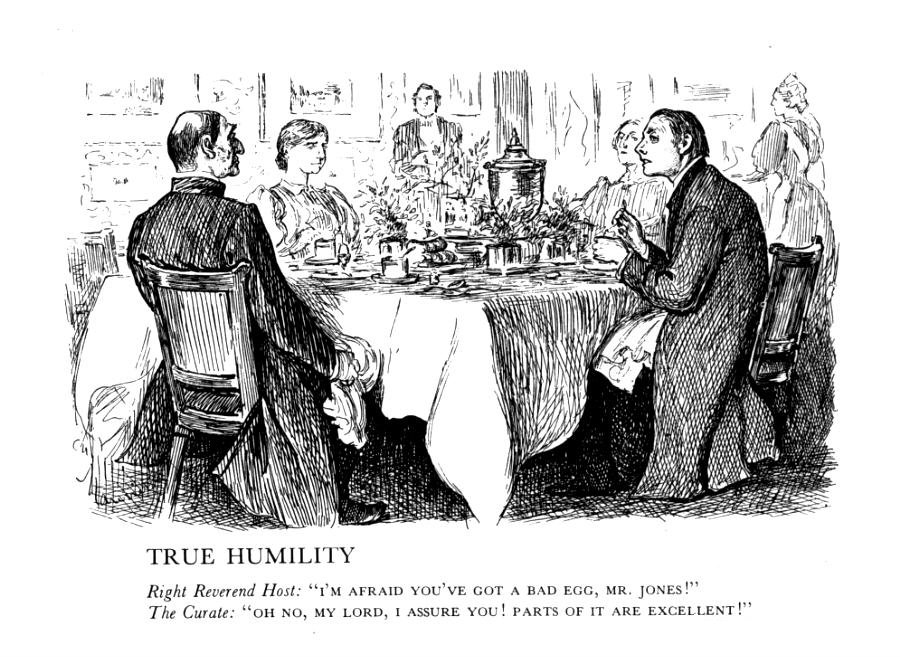
You don't often hear the catchphrase, "Parts of it are excellent," anymore, but this is the source: An 1895 Punch cartoon in which a hapless young curate attempts diplomacy. Clicking on it should provide a larger image, but the caption reads:

TRUE HUMILITY:
Right Reverend Host: "I'm afraid you've got a bad egg, Mr. Jones." ............ The Curate: "Oh, no, my lord, I assure you! Parts of it are excellent!

Thursday, July 13, 2006


Slim burns the flag

This is one of two columns I repeated in the decade or so that I was a columnist. It first ran in the Press-Republican of Plattsburgh, NY, in 1990, then again in 1999 when it became relevant again, and is copyrighted to them.

I've been kind of watching to see if I wanted to run it now, but since Garry Trudeau seems to be providing an illustration for it today, well, here it is ... (How long ago was 1990? I had to explain who "Cliff" was.)

*****************************

It was about 7:30 in the morning, July 5, 1970, when Slim decided to burn the flag.

The rest of us were asleep, recovering from a day-long celebration of the Fourth that had included barbecued chicken, rock and roll music, firemen, policemen and dog catchers.

It was a bodacious party.

Slim was over at 7:30 in the morning to see what was happening, and decided it would be a good time to burn the flag. Slim didn't live at our house, but he was over all the time and no one wanted to tell him to get lost.

You know Cliff, the guy on "Cheers?" OK, picture him about 18-years-old, wearing sandals, shorts and GI T-shirt and a string of beads around his neck.

That's Slim, and, like Cliff, nobody could really dislike him. But, like Cliff, he made it pretty hard for anybody to like him, either. He was just there all the time, being an expert and having great ideas.

Now let me try to explain the firemen, the policemen and the dog catchers.

The party was a little loud. The party was a lot loud. Someone in the neighborhood objected to our loudness and, I guess you might say, our entire way of life, which involved a lot of music and laughter and what TV Guide would call "zaniness."

So this neighbor just called every authority in the phone book. The firemen came to inspect our back alley for weeds. The dog catcher came to see if our dogs were running around without leashes. The policemen came to tell us to turn down the music. The policemen had a little chicken and we turned down the music.

The next morning, Slim decided the best thing to do would be to burn the flag. Slim figured that he would impress us with what a radical cat he really was. Now, if he had burned his draft card, he wouldn't have been able to get served anywhere, but the flag was still hanging from our porch roof from the day before.

So Slim took the flag down and started to burn it, but it didn't burn very well. It just sort of scorched, and the match burned down and then Slim noticed that his fingers seemed to be more flammable than the flag, so he shook out the match and tried to decide how to get the flag to burn a little faster.

We didn't keep a lot of accelerants around the house, but Slim had some firecrackers, so he took his knife and sliced them up and rolled the black powder out into the bottom of an empty, galvanized garbage can. Then he held the flag so it was half in the garbage can and he dropped a match into the bottom.

The windows didn't rattle, but there was a noticeable bang as the powder flashed in the garbage can. And the idea worked: The flag caught on fire.

So did Slim's eyebrows and mustache. The first people out of the house found Slim stumbling around the front yard slapping himself in the face, not so much blinded by the flash as by the ashes in his eyes. A normal person would have been a little terrified by this experience, and Slim probably was, too, but he was still Slim, so he crowed about what a great idea it was and how he had burned the flag with this dramatic gesture of revolutionary fervor.

The rest of us weren't so impressed. For one thing, it was our flag he had burned. For another, burning the flag was a dumb gesture. However we felt about the war and some other issues, we were all Americans, after all.

But we figured Slim was going to keep on being Slim, even with no eyebrows or mustache and with blisters all over his face. There wasn't much point in yelling at him and getting the place in a turmoil.

Instead, we devoted our energies to polling the block to find out who had called the authorities the day before. It turned out to be this retired professor who thought we were just terrible, disturbing the neighborhood where he had lived for 40 years with our music and our shenanigans.

We realized he had a point. We didn't tone it down a whole lot, but we started popping over from time to time to visit him and he turned out to be a pretty nice guy. He got to know some of us, and we got to know him and we found out we could live together after all.

Which is the way civilized people handle their differences. You try to understand the people you disagree with, and you usually find you don't disagree all that much after all.

As for the ones like Slim, that no one can understand, you ignore them and let them go their own, silly way. You don't make a federal case out of something that was only a flash in the pan.

Wednesday, July 12, 2006


Wow. Change of topic. Never mind the World Cup.

Riverbend, a young Iraqi blogger, has more important things to talk about.

I'm reminded of a Vietnamese woman I met at the University of Toronto during the war who explained that it didn't really matter to the average Vietnamese who was in charge in Saigon. They just wanted to not have tanks roll through their rice paddies crushing the dykes. They wanted everybody -- US, ARVN, North Vietnamese -- to just go away and leave them the hell alone.

Perhaps one potentially critical difference, judging from a couple of lines here, is that a large number of educated, middleclass Vietnamese stayed until the debacle at the end, because the cities were relatively secure. The young woman I met was in Canada to go to university and had every intention of returning to Vietnam once she had her degree.

But there doesn't seem to be a safe place to be in Iraq and you have to wonder what kind of brain drain is occurring and how it will impact the attempt to create a stable, productive society there.

They need people like Riverbend, and we need to stop pissing off people like Riverbend and breaking their hearts and crushing their souls. And I don't know how you can do that, when you broke all the eggs before you admitted that you have no recipe for omelets.

"You who build these altars now
To sacrifice these children,

You must not do it anymore.
A scheme is not a vision

And you never have been tempted
By a demon or a god.
You who stand above them now,
Your hatchets blunt and bloody,

You were not there before,
When I lay upon a mountain
And my father's hand was trembling
With the beauty of the Word."
-- Leonard Cohen "The Song of Isaac"


Please go read her blog, "Baghdad Burning."
http://riverbendblog.blogspot.com/

(Later) Here's an interview with Riverbend in which she talks about her own background, politics and motivation for blogging.

Tuesday, July 11, 2006

This week in Drawing Conclusions, we look at the death of Ken Lay ... and make jokes. Poor guy, doesn't anybody shed a tear for him? (Check out the trivia question at the very end.)

And Nellie visits Pamplona, which really was a pretty sleepy place until some Yank poseur made the rounds and wrote a book about it.


http://www.nelliebly.org

Huh? By what logic, eh?

I was intending to respond to Jimmy Johnson's request for enlightenment on the appeal of the World Cup, but am kind of tied up earning a living today. I'll try to get back to the topic, but, meanwhile, in the course of looking for cartoons, I came across this spectacular example of illogic from Rick McKee of the Augusta Chronicle.

Yes, folks, McKee explains it all: The reason Americans haven't been watching the World Cup is that we've been working to solve the crises of the world. The war in Iraq, nukes in North Korea, genocide in Darfur -- okay, not that one, but we've at least worried about it -- and the potential for a war with Iran (for or against, it's still been preying upon us mightily). And the rest of the world? Not a damn care, any of them! No earthquakes, no wars, no tsunami rebuilding, no missiles flying over THEIR air space, no disputed elections, no terrorist attacks.

The fact is, the whole damn world is paradise except for the US, and because of the US. And what's the result? We don't have time to watch the World Cup, nor the peace of mind to enjoy it.

Which is why we didn't watch it. Or the Superbowl last January. Or "American Idol." Or the World Series, the NBA Finals, Desperate Housewives ... Americans have given up on all forms of entertainment entirely. We're too busy taking care of the world.

Thanks, Rick. Now we understand.

When I do my political cartooning presentation in schools, besides all the examples of great cartoons, I have a few other examples. This one might make that cut.

Monday, July 10, 2006


Assuming I can work out the deadline issues over several time zones, this week's "Drawing Conclusions" is going to report on an unusual situation in South Africa, where semi-disgraced leader Jacob Zuma is suing political cartoonist Zapiro for making fun of him. Zapiro is not just a big deal in South Africa but is internationally known, so Zuma is taking on a large target.

I've got regular access to Zapiro's work, but here's the deadline issue: The politically-charged comic strip "Madam & Eve" has been tweaking Zuma's nose for the past week, and I've got permission from them to use their work in this week's feature, too. The trick is going to be getting the files here on somewhat short notice. However, I think I've got things in hand, so check in Tuesday after about 4:30 pm EDT and see what I manage to put together.

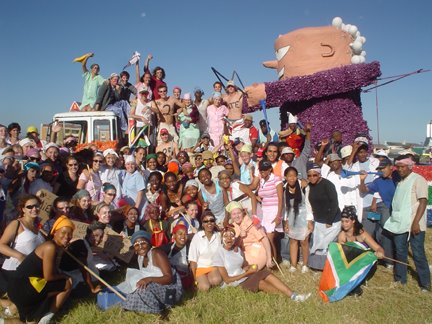
In the meantime, here's a look at the face of the new South Africa: A campus gathering from about a year ago. Imagine this cheerful crowd 10 years ago! South Africa has come such a distance, and Madam & Eve really has been part of the change -- cheerfully mocking the conventions of society and the politics of power and division through the process. The huge crepe paper statue is Mother Anderson, a character from the strip. The Madam & Eve gang put this on their Web site back when it happened, and I found it irresistable.
POSTSCRIPT: The deadline issues worked out just fine. I got hold of Rico, one of the M&E gang, and we were all set. But the taste-and-sensitivity issues proved insurmountable. The problem is that the feature is, after all, directed at children. Why couldn't Jacob Zuma have been arrested for shoplifting or running a cocaine ring? By the time I cleaned up the explanation of what he had done, it was incomprehensible and still would have lit up the switchboard. Nuts. This is a good story and an important issue, but not one we're going to explain to the kiddies.

Sunday, July 09, 2006


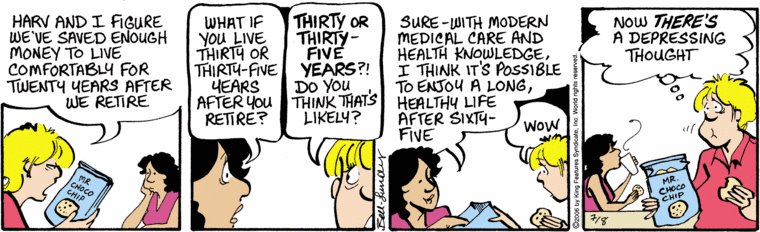
If I were planning to retire, I'd have a little less than a decade to finish setting things up -- assuming I called it quits at 65.

Now, to begin with, writers don't retire -- heck, Art Buchwald refuses to even die, much less quit writing. "Retirement" to me would mean cutting back to the point where I don't have to go into the office to do my job anymore. Or, like Andy Rooney, to have a setup where you have an office to go fiddle around in, as long as you produce three minutes of genial ruminations about potato chips or road signs each week for CBS and a couple of similarly off-the-cuff columns for the syndicate.

The other factor is that I retired at the beginning of my career. I spent 15 years trying to be a novelist. I'm glad I did, because it cleared the decks -- imagine spending all these years toiling along at work I was rather good at, but in a state of discontent because of the notion that, if I only had the time, I could write great novels instead. Having produced two novel-length manuscripts and several rewrites of each, I have disproven that idea.

Now I just work along thinking that, if I'd started earlier, I might not be so far behind my age cohort in terms of storing up mammon against old age.

Fortunately, a couple of years ago I read Peter Coyote's memoir of the Sixties, Sleeping Where I Fall, and it reminded me of what we really believed back then and the fact that, while some of the specifics were naive, the core beliefs were not. I'm content with where I have landed and how I got here, and, while I think the sorts of work we reward with large amounts of money are not always those that do society the most good, I'm only bitter about it when my 12-year-old car breaks down.

That said, Sandra Bell-Lundy's cartoon cracked me up yesterday. Scary thing is, this is a CANADIAN talking. I guess it's one of those times when an American reader has to wonder, did she already convert those projections to American measures? 'Cause I've got a pretty good sense of how the exchange rate between our two countries works out in terms of Social Services, and it's not in our favor!

Friday, July 07, 2006


Ralph Ginzburg 1929-2006

Oh there's a dirty paper using sex to make a sale

The Supreme Court was so upset, they sent him off to jail.

Maybe we should help the fiend and take away his fine.

But we're busy reading Playboy and the Sunday New York Times

And I'm sure it wouldn't interest anybody

Outside of a small circle of friends
-- Phil Ochs


"After all the legal, moral and psychological arguments are done, the fact remains that a man is going to prison for publishing and advertising stuff a few years ago that today would hardly raise an eyebrow in your dentist's office. This is the folly, the menace of all censorship -- it lays down rules for all time which are ludicrous a short time later.

"If it is right that Ralph Ginzburg go to jail, then in all justice the same court that sentenced him should proceed at once to close down ninety percent of the movies now playing and the newspapers that carry their advertising. Compared to the usual run of entertainment in this country, Ginzburg's publications and his ads are on a par with the National Geographic."
-- Arthur Miller


When will they ever learn?
I look at life as a series of opportunities to make this world a better place. One reason there's a problem is we've confronted them. The status quo was unacceptable to me. And therefore, it's important to deal with problems before they become acute.
-- George W. Bush, interview with Larry King, July 6, 2006

Wednesday, July 05, 2006


Semi-busted.

I got together with the kids this weekend and gave them the exquisite pleasure of busting my chops.

"I see you've got an EZPass," my son remarked.

"Yes, with your grandmother living downstate now, I finally gave in," I said.

"So," he nodded, "you don't want 'them' to know what groceries you buy, but you don't mind if 'they' know where you go and when?"

Hmm. Okay. Yes, I've railed against Price Chopper's discount card that tracks your purchases. And yet here I was leaving an electronic record of each time and place I drive through an EZPass booth.

I muttered something about everyone having a set of limits or something and left him smirking, but I thought it over on the way home -- a four-hour drive that, as it happens, involved not one single EZPass booth.

To begin with, we do each have our own limits. I think I'd feel differently if Price Chopper had a "marketing sample club" that anyone could join, and which offered a three-percent discount across the board. But I object to the way they advertise prices on the assumption that, yes, of course you have one of their cards. When they say bananas are 23 cents a pound, of course that's for their buddies only, but everyone is one of their buddies, right? It's not really bait-and-switch, because they DO specify "with Advantage card."

I guess I object to the assumption that we're all willing to be tracked and that giving up your privacy is completely normal and banal.

Privacy should be the default. If I choose to give it up, fine. But I'm insulted by the notion that I ought to, and by the assumption that I will.

Especially since I give it up all the time, willingly. You don't have to pay me.

Which brings us to the second part of the answer, which is that EZPass isn't the same as the Price Chopper card. Yes, they could use it to track my movements, but they could subpoena my credit card or cell phone records and achieve the same thing. You'd have to live on a cash basis if you really wanted privacy.

All EZPass is, really, is a way to use a card without stopping. There's no discount -- just the chance to avoid fumbling for change and to avoid sitting in the line at the staffed booth. Basically, the same sort of "convenience" benefit you get whenever you use a debit or credit card.

All of which Sonny Boy knows. He just gets a kick out of giving the old man some grief.

But let's go back to Price Chopper a minute. What's wrong with them wanting to track how various demographic groups shop?

For one thing, by offering specific bargains, they're spoiling the sample, unless their goal is to find out how various demographic groups respond to a 10 cent discount on bananas. An across the board discount for those who agree to be part of the study would be more valuable for purposes of sampling -- and it might increase shopper loyalty because (A) we'd think we were saving money overall and (B) we'd feel we were part of a special group and were getting special treatment.

Would I accept the card under those circumstances? I'd be more likely to if all they wanted was my age, income, ZIP Code and marital status -- but not my name or specific address. But if they were also going to mail me notices of special offers, well, gosh ... we all have our price.

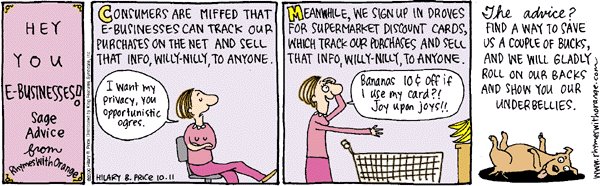
Wrote the guy who wants his own work on password-protected sites, but gets pissed and closes out of a site when he's asked to register.

(The illustration is from Hilary Price's brilliant strip, "Rhymes With Orange," and is dated Oct 11, 2000. If you can't read it, click on it and it opens in a separate window and will be a little bigger.)

Tuesday, July 04, 2006


Tom Toles: Cartoonist and Prophet

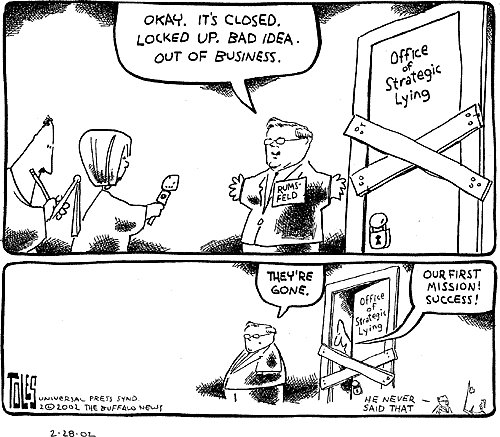
Remember back when the administration proposed creating a phony news bureau -- that is, a bureau that would produce phony news? There was an awful outcry, and the idea was abandoned.

At least, that's what they told us. And, on Feb 28, 2002, here's how Tom Toles summed up the short-lived experiment.

Now, here's a rumination on the NYTimes/White House kerfuffle, from the New Yorker: http://www.newyorker.com/talk/content/articles/060710ta_talk_remnick

Why put out phony news when you can succeed in making the real news LOOK phony?

Interesting times we live in.

Monday, July 03, 2006


Just in from celebrating the Fourth with the kids ... this involved a long drive and a lot of fun.

So in lieu of a well-considered blog entry, I offer this headline from July 16, 1920, which I retrieved from the microfilm records of the Plattsburgh Daily Republican probably a week or two prior to July 16, 1995, when I was researching the "75 Years Ago" segment of a piece I did each week.

It caught my eye.

The fact that it didn't apparently catch a copy editor's eye suggests that either the phrase didn't have that meaning back then, or the Lt. Gov. was from an opposing party.

Sunday, July 02, 2006


Happy Fourth of July

Please report all incidents of flag desecration to your local office of Homeland Security.

Thank you, and drive safely.

Saturday, July 01, 2006


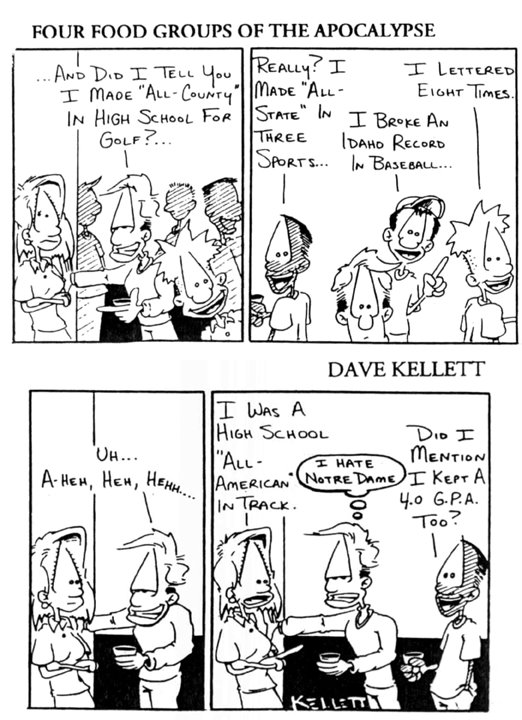
Dave Kellett currently does a comic strip called "Sheldon," which is on comics.com but not yet released for syndication in print, despite what I suspect is a growing audience, since he's got a book coming out this fall.

But Dave and I go back farther than Sheldon, because we went to school together at different times. At my 20th reunion, I got into a conversation with some of the students who were working the affair and the result was a monthly column de-mythologizing the '60s in the Observer, Notre Dame's daily paper, which ran throughout the 93-94 academic year. And, of course, I had to subscribe to see what else was being discussed so my columns would be relevant.

That was when Dave's comic strip, "The Four Food Groups of the Apocalypse," began running, and I became a fan. When I was rummaging around in my attic looking for something else, I came across this example of the strip. It was good stuff then and it's held up well, though of course there's a lot of "you had to be there" in this gag. But that's how local strips should be!

(Note: I've placed the panels two on the top and two on the bottom to make it more legible, but it -- perhaps obviously -- ran on a single level originally.)

One of the bookmarks on my menu of daily stops is Slate, which replaced Salon but might find itself deleted soon. It currently features a "debate" about Wal-Mart between Jason Furman, described there as "a visiting scholar at New York University's Wagner Graduate School of Public Administration" and Barbara Ehrenreich, author of "Nickeled and Dimed" for which she took a job at Wal-Mart.

Here's where the piece started going off the rails - Jason Furman in the first installment of this back-and-forth writes:

I myself have never worked at Wal-Mart, and I can only remember shopping there once.

and, later in the same installment:

The single most careful economic study, co-authored by the well-respected MIT economist Jerry Hausman, found that grocery sales by Wal-Mart and other big-box stores made consumers better off to the tune of 25 percent of food consumption. That doesn't mean much for those of us in the top fifth of the income distribution—we spend only about 3.5 percent of our income on food at home and, at least in my case, most of that shopping is done at high-priced supermarkets like Whole Foods. But that's a huge savings for households in the bottom quintile, which, on average, spend 26 percent of their income on food.

No, Jason, it doesn't mean much. Especially since you manage to eat so much better than the rest of us and keep your expenditures at 3.5 percent. And, in return, your analysis doesn't mean much to me, because, yeah, I'm spending more than 3.5 percent of my income on groceries, and if I were doing it at Whole Foods, it would be quite a bit more than that.

This is what is known in the trade as a "thumbsucker," in which some writer sits in his office and meditates upon the world. Furman has done some economic studies. Ah. I see.

Ehrenreich is apparently no less out-of-the-demographic than Furman, but at least she's put in the real-world research:

We both want higher wages and more generous government social programs; we both voted for Kerry; we're both in the upper-middle class or pretty close. The difference, I think, lies in our mental ZIP codes. Where you see some unfortunate, but not really all that bad, numbers, I see human crises, and I see them in my extended family and my network of friends as well as in the letters I get from readers: The car that gets you to work breaks down and is going to cost $200 to repair. The baby gets sick so you miss a day's work and face the possibility of losing your job. Your back goes out and you can't scurry around the floor picking up tossed merchandise any more.


This is a polite way of telling Jason he doesn't know what the hell he's talking about. And much as I get tired of shout-fests and debates that degenerate into abuse, I think if she'd been a little more direct, I wouldn't be deleting Slate from my daily bookmark menu.