Thursday, August 31, 2006


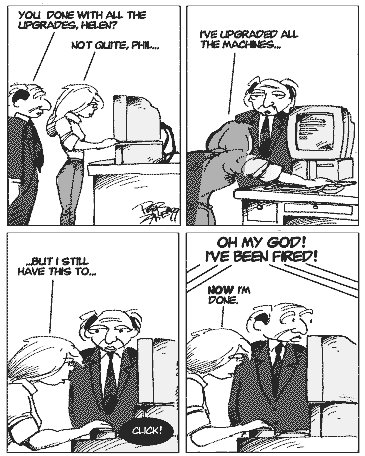
I'm sure this will get plenty of play, but I wanted to point out that yesterday's "Helen, Sweetheart of the Internet" joke is tomorrow's news story.

FORT WORTH, Texas Aug 30, 2006 (AP)
— RadioShack Corp. followed through on its announced plans to cut about 400 jobs, but the electronics retailer has been forced on the defensive about its method of notifying laid-off employees by e-mail.

Employees at the Fort Worth headquarters received an e-mail Tuesday morning telling them they were being dismissed immediately.

"The work force reduction notification is currently in progress," the notice stated. "Unfortunately your position is one that has been eliminated."

Wednesday, August 30, 2006


Wit from the Bench

I was researching Supreme Court cases regarding the rights of students for an upcoming series on the Constitution when I came across this excerpt from an opinion written by Justice Stevens in the 1981 case of Widmar v. Vincent. In that case, the court ruled that the University of Missouri was wrong to ban the use of campus facilities by religious groups, saying that while the university had the right to set rules, they couldn't single out religion as a banned content area. In his concurring opinion, Stevens sought to emphasize that requiring fairness was not a requirement that schools give up any attempt at critical judgment:

Because every university's resources are limited, an educational institution must routinely make decisions concerning the use of the time and space that is available for extracurricular activities. In my judgment, it is both necessary and appropriate for those decisions to evaluate the content of a proposed student activity.

I should think it obvious, for example, that, if two groups of 25 students requested the use of a room at a particular time -- one to view Mickey Mouse cartoons and the other to rehearse an amateur performance of Hamlet -- the First Amendment would not require that the room be reserved for the group that submitted its application first.

Nor do I see why a university should have to establish a "compelling state interest" to defend its decision to permit one group to use the facility and not the other. In my opinion, a university should be allowed to decide for itself whether a program that illuminates the genius of Walt Disney should be given precedence over one that may duplicate material adequately covered in the classroom.

Tuesday, August 29, 2006


Drawing Conclusions goes light on the politics this week with a look at Pluto's demotion through the eyes of the Toronto Star's Dave "Andy" Anderson and the Detroit News's Henry Payne.

Meanwhile, Nellie Bly takes the anniversary of Katrina as an occasion to do a little reflecting on how tight deadlines and bogus numbers intersect in the news business.

http://www.nelliebly.org

Sunday, August 27, 2006


Bogus pop-up of the day

Yeah, I think I saw these girls the last time I drove through Fort Edward.
They had the spreader loaded and they were headed for the hayfield.
(Yes, I sometimes lie about my exact location when registering.)

Saturday, August 26, 2006


NYTimes exclusive: Water is a drowning hazard! (and math is hard!)

HONOLULU, Aug. 25 — The blue waters surrounding the Hawaiian Islands may be irresistible, to tourists and residents alike, but swimming there — or surfing, snorkeling, diving or kayaking — can be deadly. And not just for the reason that seizes the imagination.

What? The reason that seizes my imagination is that the ocean has a pretty high water content, not to mention rip tides and such.

While it is the infrequent shark attacks that make the headlines, (Oh, right. Jaws. Okay, carry on.) drowning claims far more lives in Hawaii, where coastlines of sand, coral reef and lava rock create shorebreaks and currents that cause many swimmers to encounter peril entirely unexpected. Indeed, most of the victims are adults who thought they were good swimmers.

(Okay, I can live with "many," though "entirely unexpected" gives me a slight case of the collywobbles. But could we get a source for that last statistic -- drowning rates among adults who self-rated their swimming ability as "good"?)

“The waters at many beaches are deceptively beautiful,” said Dr. Chiyome Fukino, the state health director. “Even if you know how to swim, if you get into nasty surf, if you’re ill or injured, your chances of drowning are increased.”

Seventy-one people drowned in Hawaii in 2004, 58 of them in the ocean. The toll was the highest here in 15 years, but then was eclipsed by last year’s total of 77.

It is not just the millions of tourists who are at risk. Nearly half of all drowning victims are residents, a statistic that gives Hawaii an exceptionally high per-capita rate. The state’s Department of Health reports that from 1999 to 2003, 9.7 people drowned for every 100,000 residents, more than double the national rate of 4.7. That made the state’s rate for the period second only to that of Alaska, where fishing accidents account for a large share of drownings.

Let's go back to the "half of them are residents" part. Is she saying that the 9.7 per 100,000 stat is based only on dead residents? If so, why doesn't it say "9.7 Hawaiians drowned ... "

A look at Hawaii's Dept of Health suggests that she's counting the tourists despite having just excluded them. I couldn't find the exact figures she's citing (and I do have to get back to work on my paying job), but here's what a quick search turned up:

G. Drowning Deaths

Current status and trends in Hawai`i

Drownings are the second leading cause of unintentional injury death. Each year in Hawai`i, there are nearly 50 drownings and over 100 water-related hospitalizations occurring mainly from activities in the ocean and pools. Hawai`i has more ocean-related drownings and injuries leading to death and disability per square mile than any other state. Nearly half of all ocean-related drownings and hospitalized injuries occur to non-residents, therefore de facto population estimates yield a more accurate injury rate.

Healthy Hawai`i 2000
Objective Baseline (1990)47 and current data

9.H Reduce drowning deaths to Drowning deaths 1990 1991 1992 1993 1994
no more than 3.0 per 100,000 among state residents 4.4 2.5 3.2 3.4 3.4
people. Drowning deaths 5.3 3.6 3.8 4.3 5.3
inde facto population

NOTE: Hawai`i's baseline for this objective is not resident population-based, as it includes visitors. Therefore, it can not be compared to the national objective.
47Hawai`i Department of Health Status Monitoring, Vital Statistics data, special tabulation.

She goes on to talk about the videos they're showing tourists to warn them about the dangers of the ocean -- pretty much recycling a story that ran two months ago in the Honolulu Advertiser, but not ripping it off. Just not improving on it much. The difference being that the Advertiser ran some fact boxes that, while more current than the ten-year-old figures in this DOH report, were closer to this rate than the 9.7 quoted by the NYTimes writer.

And the Honolulu reporter didn't automatically assume that, when readers think of hazards in the ocean, they imagine Jaws.

Tuesday, August 22, 2006


This job description is a lot funnier if you understand journalism pay scales

Company: Democrat and Chronicle
Position:
Business reporter
Location:
Rochester, New York
Job Status: Full-time
Salary: Not Specified
Ad Expires:
September 22, 2006
Job ID: 672529
Description:
We’re seeking an enterprising business reporter to cover fast-developing medical tech and biotech industry, including Bausch & Lomb, one of the world's largest eye-care companies. The reporter will think new media, eager to break news on our website and bring a flair for good writing to Page 1A and the Sunday and daily Business sections of our newspaper (160,290 daily and 219,660 Sunday). On the multimedia front, this reporter should be prepared to do podcasts, collect audio interviews, work with videographers and appear on television with the local ABC affiliate as needed. Interested? Please contact Neill Borowski, managing editor, the Democrat and Chronicle, Rochester, NY. Email jobs@democratandchronicle.com and nborowsk@democratandchronicle.com.

(cartoon is Between Friends by Sandra Bell-Lundy)

Friday, August 18, 2006


Here we go again.

School is just around the corner and I've got mountains of stuff to get done in the next two weeks. This year's serial combines mythology and astronomy and, unfortunately, I don't really know much about astronomy except what I learned in Earth Science ... well, so long ago that some of the stars have moved since then. I'm way out of my comfort zone with this stuff, but it will be pretty cool when I'm done. (Fortunately, I have the help of a friend. Unfortunately, he's out of the country.)

Which either means I won't be updating the blog much or else I'll be posting a lot, and so, by checking in here, you'll be able to tell whether I'm hunkered down or blissfully avoiding what must be done.

The illustration here is a favorite Peanuts simply because so many NIE programs base their entire educational approach on goofy fun stuff of no real value in the classroom. A classic request on the NIE listserv is "Does anyone have the directions for making a pressman's hat?" While I have nothing against making hats, I wish that request was at least equalled, if not outnumbered by, "Does anyone have any really good First Amendment resources?"

In any case, I'll be in the office much of the weekend and I won't be folding hats.

Sunday, August 13, 2006


No pida, no diga

(an Ecuadorian pamphlet my co-worker, Peggy, came across. A translation I cobbled from Babelfish.)

Thursday, August 10, 2006


Arthur Lee died the other day. That won't matter to very many people, but it will certainly be noticed by those who knew who he was.

About ... gee ... was it 20 years ago? More or less. Anyway, I was at a college reunion and my buddy Charlie came by, even though it wasn't his year, and we played a little guitar music together. We played "Signed DC" and "A House Is Not A Motel" and then were piddling around with a kind of funny one called "Live and Let Live."

I mentioned that, since I'd left school, I hadn't run into very many people who had even heard of Love, much less knew any of their songs. And Charlie off-handedly remarked, "Well, they were a musicians' band." And I realized it was true -- the people who I associated with the group were almost all musicians, or very close to the music scene.

The thing that was different with Love was that a lot of the bands that are "musicians' bands" are so esoteric that nobody would want to listen to them except to marvel over (and steal) certain licks. But Love was incredibly listenable music, with nice, accessible instrumentation (easier to listen to than to play) and a kind of baroque lyrical sense that Jim Morrison could have learned from. And apparently did.

Funny thing: One of the obits I read quoted a line from "The Red Telephone" as an example of Arthur Lee's genius. The line -- "They're locking them up today. They're throwing away the key. I wonder who it will be tomorrow, you or me? (We're all normal and we want our freedom!)" -- was often quoted back then. But the line was taken from "Marat/Sade." (The lyrics linked here attribute the song to Bryan Maclean, but it's by Lee. Except, y'know, for the line everybody quotes.)

And speaking of locking people up and throwing away the key, for awhile back in those days, I lived next door to a guy who was on a "perma-trip." Steve had dropped acid one time and never really came down again. It had been awhile and, though he was from Washington, DC, he was in South Bend at the moment because his buddies took turns watching out for him, and a couple of them were living out there. He wasn't at all trippy or goofy -- actually, he was very quiet and very nice, but you couldn't really hold a conversation with him. I don't think he was hallucinating. He'd just completely lost his ability to focus. He'd get various shelf-stocking sorts of jobs but he couldn't hold it together and he'd just kind of not work, and either he'd get fired or he'd stop showing up.

But one thing he could still do was play guitar, and he could play every song Love recorded, really well. He was a human jukebox, and there are several Love songs that still remind me of Steve, sitting up in his room playing. He went back to DC after a couple of months and I have no idea what happened to him. I kind of hope someone a little more grounded than his buddies eventually took over his care and feeding.

For that matter, I wish someone more grounded had been able to take over Arthur Lee's care and feeding, because he certainly put himself through some unnecessary things. One of those obits where you're sorry he's dead, but you're also kind of surprised he was still alive.

Anyway, lots of memories and associations, some sublime, some ridiculous. I don't know why this band wasn't more popular. But if you read the obit linked to Lee's name at the beginning, you'll see that a lot of later-to-be-popular bands were listening to him.

Wednesday, August 09, 2006


Bear in Hammock video -- A public service

Ronnie writes: "You know, Mike, I think that forevermore I shall think of incredibly stupid, inane, vapid media fluff pieces as "bear in a hammock" stories."

Especially if you were alone in a hotel with no Internet access and this clip, playing over and over on the news. Admittedly without the annoying soundtrack.

Or the potential bruises of this poor bruin's endlessly replayed adventure.

Tuesday, August 08, 2006


This week in "Drawing Conclusions," Dr. C. Rice gets skewered by the pens of Robert Ariail and Etta Hulme.

And on a lighter, but historically interesting, note, Nellie Bly looks into the significance of Warren Moon's induction into the Pro Football Hall of Fame.

Clueless in cyberspace

I liked this "Monty" strip that ran last week, but I'm not so sure about this article from C/Net news. It seems that, when AOL coughed up the search records of its customers recently, it was possible to piece together what various (anonymous) individuals have been searching for on AOL's own search engine.

Now, granted that AOL users don't have a reputation for being cybersavvy -- and if you eliminate the ones who would have used Google or even Yahoo! as their search engine of choice, you're not really providing a cross-section of the surfing public.

But still. The topics are amusing or depressing or alarming, yes, but the search terms ... do these people think the Internet is a Magic Eight Ball?

Nonsense. The Internet is not a Magic Eight Ball. It's a series of tubes.

Sunday, August 06, 2006


Or nearly so. Rob Harrell's Big Top shows the potential for this newest of X-sports. Hey, if poker and hot-dog eating can be sports, I see no objection to this!

Friday, August 04, 2006


My friend Ronnie sent me this Op-Ed piece from the NYTimes. It's by a guy who found himself on a commercial jet with a Marine escorting a comrade-in-arms to Arlington. Very moving, and from an unusual source -- an anti-hunger activist whom I suspect is embodying the notion of putting politics aside and respecting love and sacrifice.

It came at an opportune time to set my wheels rolling. Last weekend, I went up to Star Lake to help my aunt and her brother shut down the family home there. My mother has moved to the city, not because she doesn't like being in the middle of the Adirondack forest but because it's just time for her to be a little closer to services. Driving 40 miles for this and 50 miles for that becomes a burden, no matter how glorious the surroundings.

We moved there 50 years ago this coming Labor Day and it will always be home to me, though, in fact, I only lived there about 10 years -- from second grade until I left for college. But I'd go back at least once a year, no matter where I was living, and I moved back East nearly 20 years ago, just to be near.

It was hard to know that I wouldn't be going back again except for very important occasions, most likely involving my old buddy Digger, who took over the family mortuary. (And, yes, everyone still calls him "Digger.") In fact, the next-to-last thing I did on the way out of town was to stop off and see my best friend from those days, Bill. And I said, "Oh, I'll be back. I have a piece of property up here, you know." He was surprised until I told him where it was, then he chuckled. "Yeah, I've got some property like that, too," he said.

The last thing I did was to stop by that small piece of property, where my Dad and little brother are.

Anyway, this picture isn't from that particular corner of Star Lake, but from Newcomb, another Adirondack hamlet which, hard as it is to believe, is even smaller and more remote. Newcomb Central School typically graduates classes of 3 or 4 students, though in one recent year they had a senior class of 7.

I was up there a year and a half ago just before Veteran's Day, talking to the high school kids about political cartoons. At noon, we went down to the cafeteria and half the town was in there for a Veteran's Day program, complete with music and lunch for all the area vets. The elementary school kids -- all two dozen or so -- sang the various songs of the branches, and, when they'd sing a song, the veterans of that branch would stand. Most were older men, grandfathers and perhaps great-grandfathers of the singers, the younger vets being off at work, probably an hour away, jobs being scarce in the woods. But others were not related to any of the kids; they were there because they'd been invited. It was a community event.

It was a very simple ceremony but one of the most moving I've ever attended, because it was so personal -- everyone there knew everyone else. And they all grew up, as we did in Star Lake, with a type of patriotism that truly was love of country. When the country calls, you go. And you can argue politics at the bar until closing time, but that is another topic. Young men serve.

When I was in college, I was keenly aware of how little my classmates there understood this, that they didn't see the divide, the duality, that I operated under. I opposed the war, but my buddies, my friends, were there, in Vietnam and mostly out in the field.

I wasn't conflicted in the least by that. Politics was here. Service was there. Maybe it's like when you offer some homeless person a little help, without agonizing over whether it's going to victimize him or let him get drunk again or keep him dependent -- you just help him because he needs help, and you can theorize about it in another venue, another time. When it's time to help out, that's what you do.

If you can't see the little orange blobs in the photo above, click on it and it will come up larger. This is the cemetery at tiny little Newcomb, and every one of those little orange blobs is a Semper Fi flag, on the grave of some country boy who put down his deer rifle and picked up an M-1 or an M-16 or whatever tool they handed him. Most of those country boys went off and did what they were asked to do, and then came home and, like John Stark or Cincinnatus, picked up the reins and got back to work, God bless them.

God bless them.
Tuesday, August 01, 2006


This week, "Drawing Conclusions" looks at civilian casualties in Lebanon through the eyes and pens of Ann Telnaes and Kal. It's really one of the better pairings of panels we've had.

And Nellie Bly travels to the Democratic Republic of Congo to report on the elections.

A bonus link: While I was looking for updated casualty figures for "Drawing Conclusions," I stumbled across this. Simple but effective.

Monday, July 31, 2006


I was thinking about Jerry Bittle the other day. Jerry was one of those friends that you meet on-line and think that some day you'll get together and have a beer and talk deep into the night. That actually happened to me with an on-line buddy -- we were up until nearly 4 a.m., laughing and talking and finding out that we got along just as well in person as on-line.

It didn't happen with Jerry because, before we could get together for those beers, he took a vacation to Central America and somehow had a heart attack while he was scuba diving.

And he left behind a wife and a couple of daughters and far more grief than my losing out on a night of beer and giggles.

But there is still that frustration -- He was working on a new strip, "Shirley and Son," about a divorced family. It was the most compassionate, wonderful, hilarious strip I've ever seen -- absolutely one of a kind. Dammit, I wanted to see how it came out. And I'll bet he did, too.

At the end, in the story arc Jerry was working on before his vacation, Shirley was starting to date, and I told Jerry I was about to go on a date from one of those on-line dating services. Her pics on the Web site looked good, I said, but I was a little concerned because she was a graphic artist. He wrote back that he wanted to hear all about my "Photoshopped blind date" and I meant to tell him all about it, but put it off. And ... well, then it was too late.

It certainly wouldn't have mattered in the grand scheme of things for him to have known that she invited her entire family along on the date, but he certainly would have gotten a huge laugh out of it. And I felt bad that I could have told him, but put it off because, after all, there's always tomorrow.

Jerry's bread-and-butter strip, "Geech," was a genius piece of timing. It was like the Bob Newhart Show -- the real one -- where you knew, as soon as Bob said, "I just want a quiet evening with no interruptions," that Howard was going to come through the door -- you knew it, but you laughed because it was like being in on the joke.

Geech was like that -- yes, predictable, but that was part of the fun. Rabbit would never go to Artie's for dinner. Ruby would never get a date. And the bathrooms at the gas station would never, ever get cleaned.

But with "Shirley and Son," he was reaching beyond brilliance. How he could be so knowing and compassionate without being divorced was a mystery to me. But he said he listened to his friends. Jerry Bittle was one hell of a listener.

I have a couple of missing friends who I wish I could have one more email exchange with, even if we never did get to drink those in-person beers. Jerry Bittle is absolutely the name at the top of that list.

By the way, his stuff is still available on-line here and here.

Thursday, July 27, 2006


Back in June, I wrote about the inanity of network news, particularly the morning shows, which, at the moment, were endlessly replaying footage of a bear trying to climb into a hammock.

It may surprise you to know that Stephen Colbert can be even more incisive on the topic. I found this on Arianna Huffington's Web site, which in turn got it from Atrios.

Wednesday, July 26, 2006


This week, Drawing Conclusions looks at the Lebanese crisis through the eyes of Israeli cartoonist Kichka and Lebanese cartoonist Stavro.

Meanwhile, Nellie Bly looks at "signing statements." Turns out W didn't invent them, he just perfected them to the point where they became a crisis. I would urge you to check the fine print at the bottom of the feature and take a look at the actual ABA report -- fascinating stuff.

http://www.nelliebly.org

Tuesday, July 25, 2006


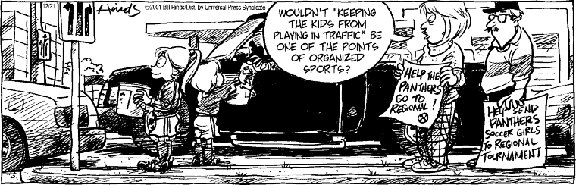
Hope none of their parents are attorneys

This is a very early strip from "Cleats," which is one of my favorites. Bill Hinds, the artist-half of "Tank McNamara" and creator of "Buzz Beamer," a strip in Sports Illustrated Jr., is artist and writer on this one, which is about kids in rec sports. (A very early strip indeed, come to think of it. Visit the Cleats site for a look at how a strip evolves -- or is intelligently redesigned -- over five years or so.)

But this particular strip was the one that made me a Cleats fan -- it touched on an exposed nerve.

I keep waiting for some town attorney to pipe up at a meeting some time and say, "Do you know how much trouble we'd be in, if some kid got hurt doing this, and we issued the permit for it?"

And yet every summer, you've got the sports teams out at intersections in towns that aren't nearly as small as they used to be, panhandling for spare change from passing cars. Granted, the kids aren't often this young, but it's still an awfully foolish and annoying thing to do.

I don't have the same feeling about "boot drives," where the local volunteer fire department asks for contributions. I figure, if I'm ever driving through that town and end up in a ditch, those are the guys who will come get me out -- either as firefighters if it's serious or, if it's not, just as friendly guys who happened to come by.

But it's been a long time since I've had the kind of travel emergency that required me to attend a rec league game.

I also have no problem with the kids jumping up and down on street corners, waving signs beckoning me into the car wash. That's my choice, and if I've got a couple of bucks and dusty car, I'll succumb once in awhile.

But that's a far cry from "aggressive panhandling," which is what they call it when someone without a permit starts walking up to cars at stoplights and asking for change.

I believe in youth sports. But dodging traffic shouldn't be one of them.

Sunday, July 23, 2006


Chuck Perrin, who runs a jazz club in San Diego, is a vestige of the old folk days in college. He was two years ahead of me and already famous when I arrived -- He'd fronted a major campus rock band and then opened a coffeehouse to showcase the emerging folk scene. He also acted in plays on campus, did some dj'ing on the campus radio station and ran a quixotic campaign for Student Body President. This was a campus of only 8,000 undergraduates, so it didn't take much to become well-known and any two or three of those would probably have done it.

By the time he left, though, he knew who I was, and when I put together a campus folk reunion in 1994, he came along and did a dynamite set. We revisited the idea last summer, only instead of being formal and having microphones and an actual venue, we just went to the house of one of the guys who still lived in town. That's Chuck playing, and the young person with pigtails in the foreground is his daughter, Asa.

It sure was interesting to be in a group of people who knew what they were listening to, as they each got up and took a turn on the folding chair, but let's not be age-snobs about it. Asa and the handful of other folkie offspring at the affair weren't the only people under 50 who showed interest in the music.

The night before, we'd gathered at a small bar near campus, mostly as a place we could all find as we wandered in from New York and California and Chicago and other places, and that, with college over for the summer, wouldn't be busy. The people who wanted to chat stayed upstairs and those who wanted to jam went downstairs to a very dank and barely-finished basement where there were some long folding tables and folding chairs. The thing went on until about midnight and we started peeling off to our various hotels and buddy-housing.

The next day, it turned out that those who had left at midnight were in fine shape and those who hadn't were in rough shape indeed, because, just as things were breaking up, a bunch of college kids had come into the place, heard the music and started buying drinks and making requests. What surprised the old geezers with the guitars was that these youngsters had a pretty good grasp of the Buffalo Springfield sort of era and were asking for appropriate, excellent songs that they maybe hadn't played in 30 or 40 years. But with a dozen musicians, there was somebody who would say, "Yeah, yeah ... I've got it ... um ... " and lead off, and the rest would follow. And on they went until the barowner had to throw them out so he could close.

They told the kids this was our "anti-reunion" -- a gathering not by class year but by who you want to hang out with, and the kids agreed that this made a whole lot more sense.

Or, as Chuck had remarked back in 1994, "My class reunion is next summer, but these are the people I want to see!"

It was a great weekend of music, but it was also a great weekend of hanging out with people who shared some basic beliefs about what you ought to do with your life. It wasn't an issue of hair and lifestyle so much as the consciousness with which everybody is still working, and the number of them who are making the world a better place through their efforts -- teaching or practicing medicine or practicing law with some idea of right outcomes rather than "victories."

There are good people out there, and they don't all dress in ways that make them easy to pick out and line up on this side or that. And they aren't all 50 or 60 years old, either. Still, there are days when it feels like they aren't there, and it's good to be able to point to a moment that reminds you they really are.

Anyway, the reason Chuck is on my mind is that I discovered a new Web toy this weekend -- Pandora Internet Radio, which allows you to set up your own "stations" by choosing an artist as a starting point. The "radio station" then selects musically similar pieces, and you can correct it as it goes along by giving each song a thumbs-up or thumbs-down. You can also add artists, and, while I was fooling around with it, I typed in "Chuck Perrin" and damned if they didn't know who he was.

And now you do, too.

Pandora is a lot of fun and it's free. If you've got any kind of fast connection, go play with it. And if you have slow connections, go to Chuck's site, particularly if you like acoustic jazzy kind of thoughtful music, because he's got a bunch of MP3s you can download and then playback at your leisure.