Friday, March 30, 2007

in Just- spring when the world is mud- luscious

Yes, folks, that's my driveway in Just-spring, when the world is puddle-wonderful.

I just met my first truly droll Yankee, who lives in the house you can see to the left of the bon. He's an electrical contractor, perhaps a few years older than I am and the kind of flinty Abe Lincoln-looking Yankee that Norman Rockwell loved to paint.

As I pulled part-way into my driveway last evening, he was just pulling into his long driveway, so I backed out again and drove down to say hello. I told him I had learned, a bit too late, to park out by the road this time of year, and he told me that there's a rock ledge on the right hand side of the property (as you're looking at this) and the back that forms a nice cup right under the buildings and driveway, so that the heavy clay stays wet much longer than the surrounding area. By contrast, he said, he put in his own road maybe 50 yards away and has never had to touch it since, though he did start with a layer of roundstone for better drainage. But it would take tons of gravel to make my driveway into something you can use in the spring.

We stood and talked for about 20 minutes, during which time his wife arrived home and joined us, and I have to say it was the funniest conversation I've had since I got here and maybe the funniest I've ever had in which nobody laughed except me. Truly a droll Yankee, he delivered his lines in a classic Maine accent with a twinkle in his eye but only a hint of a smile.

He mentioned a mutual acquaintance in the general area and said, "She can be a very nice person," and when I didn't laugh, he looked at me out of the corner of his eye and added, "I said 'can be.'"

And when I had said that, if I were to be offered the house for sale, I don't think I could afford all that would have to be done to it, he agreed, telling me, among other things, that it has no septic tank, only a cesspool, and the clay leachfield doesn't absorb that stuff much better than the driveway absorbs the runoff. He characterized the house as having "no basement, just a hole that won't support a house," which is absolutely true.

That was about when his wife got home. She and I had waved across the yards, but this was our first conversation and I said, "I thought I'd come down and say 'hello,'" to which he remarked, "I was thinking of coming up and saying hello to you, but it was too muddy."

A-yuh.

Saturday, March 24, 2007

My little boy is growing up

I was cleaning out Howard's tank tonight and realized he's grown a bit. Then I realized that it's been six months since he hatched (well, six months and two weeks), and so I figured I'd take another picture of him, again with a quarter for scale.

He's certainly no trouble. Every week or two I put him in a bowl and then scrub his rocks and rinse out his tank, which isn't hard since it only has about an inch-and-a-half of water in it. And as far as expense, it's negligible -- he's still on his first packet of turtle food, though every two or three weeks I give him a chunk of raw meat about the size of the top knuckle of my little finger. (Hmm ... perhaps that's not a comparison I should share with him, lest it give him ideas.)

As far as sociability, he's no more eager to be my friend than he ever was -- snappers are grumpy, solitary characters by nature and the little ones stay out of sight for the first couple of years of their lives anyway. On the other hand, he's learned that when he sees me moving around, food is likely to happen, so he often comes out of his cave and cranes his neck to see what I'm up to.

This is a little bothersome in terms of my original plan to keep him around until he gets larger and then release him -- he really shouldn't come up to people expecting food once he gets out in the wild. But this interest in food doesn't mean he's ever going to be "friendly" and he'll certainly become more risky to handle the larger he gets.

It is a puzzlement. But he continues to amuse me and I like having him around. When he gets big enough to snip off my fingers, I guess I'll have to sit down and think it all out, but, even at this rate of growth, that's going to be awhile.

Monday, March 19, 2007


Awww ....

The puppies are bonding. (She likes me, too.)

Sunday, March 18, 2007


Sunday Funnies

Our biggest rival, the Sun Journal out of Lewiston/Auburn (circulation 36,000), maintains a bureau in Farmington but is apparently a little shortstaffed in its on-line editing department. Needless to say, we find these things quite amusing. Mostly when they happen to someone else.

Monday, March 12, 2007

Town meetings totally rock

I'm in New England now, where we have town meetings. Tonight, I covered the meeting in Chesterville, a small, not overly wealthy town just south of Farmington. I assigned our reporter to Farmington which I'm sure was much more uptown. I'd rather be in Chesterville.

Last weekend, I covered a meeting in another town that was about half "locals" and half artists and skiers. But Chesterville is totally local, and it's a wonderful example of how wrong those smart-ass city people are when they peg country folks with Deliverance stereotypes. These people aren't all college graduates -- the three in the foreground are a garage owner, a volunteer firefighter and a deputy sheriff -- but when they stand up to ask a question or make a point, you know you are listening to an intelligent person who has looked into an issue and either formed an opinion or come up with a probing question.

And the direct democracy is just a gas. Most of the time, the moderator (and there is a moderator appointed, who is from outside the town and thus neutral) -- well, most of the time, the moderator knows the name of the person rising to ask a question or make a point. It's very informal ... "Yeah, go ahead, Tim ... " and there is humor, usually aimed at the board of selectmen. It's a conversation among people who know each other and live together.

When you arrive at the town hall, you pick up a booklet that has the various articles to be voted on, as well as reports from each department within the town for the year. So you have all the tax assessments, and the budget for the animal control officer, and every other detail in the town government. Some towns get fancy and add color and a little self-promotion, others are bare bones. Chesterville was bare bones, but it was still a thick little booklet of information.

What impresses me about these meetings is the good spirit of it all. You don't have a lot of the penny-pinchers who sink so many school budgets in other areas. Most of the questions are genuine attempts to get information, and the town officials are very open to providing that information.

Two things came up tonight that impressed me. Now, let me start by saying that there were 53 articles, each of which needed an up-or-down vote. At most town meetings, the vast majority of articles are approved, since they've been chewed over by the budget committee and town board. But there are always a few that get more scrutiny than others.

My notes are out in the car, but one item was about $9,000 -- but I forget what it was for. Someone asked why it was $3,000 more than the previous year. Well, there was some back and forth on that, but then one of the selectmen (as town board officials are called) said, "We've got some reserve, so I'd like to offer an amendment ... " and he chopped off the three grand. As simple as that.

A much more complex issue came up at the end of the evening. Most of these "articles" are pretty cut-and-dried. For instance, the state licenses snowmobiles, and each town gets some of the fee back to maintain trails. The money is traditionally turned over to the local snowmobile club which is the group that actually does the work. For Chesterville in the past year, it came out to a little over $900. It would be silly not to approve the article because who else wants to go out there and maintain the trails? So that article usually passes with little discussion, although one town locally has two clubs and one of them apparently wasn't pulling its weight -- and that became a discussion point! Hey, your neighbors know when you're slacking off.

Anyway, there was a proposal to increase the minimum lot size for building to 40,000 square feet, the reasoning being that the necessary distance between wells and septic tanks made that a more logical lot size. But people at the meeting objected, pointing out that, as written, the article would forbid you to buy a quarter acre from a neighbor to put up a garage or even a storage shed, which has no impact on either wells or septic tanks. The building codes officer accepted the criticism, and one of the selectmen finally asked people to defeat the article so they could take it back and rethink it.

People of goodwill work together.

But the best moment came on an article that would give $700 to the local group that works with "special needs" people. Someone asked why it was so much, and proposed an amendment to cut it back to $150. Well, excuse me, but if you think only city liberals have compassion, you should have heard this group rise up against that notion.

What would the town do with that money that would be more valuable than helping these people, someone asked. And someone else said, "It's a small price for personal dignity." Of all the proposals that night, this one got the loudest "nay" vote for the amendment, and the loudest "aye" vote to approve the appropriation.

It comes down to this: People can be heartless when they are talking about abstractions. But you get into a town hall with your friends and neighbors, and you start talking about real life, and the generosity of people bubbles to the surface.

I wish more communities in this country had town meetings.

Sunday, March 11, 2007

Two is better

I spent Saturday sitting behind the wheel of my van, from 6 in the morning until 9:30 at night.

I drove from Farmington, Maine, to Salt Point, New York, and back, a distance of about 750 miles. Salt Point is where Melissa Carlin lives. Melissa is a breeder of Rhodesian Ridgebacks, who produced Jack, my (now) ex-girlfriend Donna's dog, and Cole, her current dog. She also had owned Nikki, an African-born champion who then "retired" to live with my son, Jed, and his family, and she was one of two breeders who produced my own dear Nellie Bly. (The other was Destry's breeder -- Nell was his niece.)

When I had to put Nellie down in December, Melissa made an offer that I turned down. She had a bitch, Ziwa, who was ready to retire from breeding and the show ring, and she wanted to find this sweet girl a nice place to live. If I wanted her, she was mine.

I pondered this for a time, but said no, that I wanted to be a one-dog family now. And I did. But Destry didn't. Now, I don't ascribe a lot of rational thought to dogs, and Des wasn't wandering around the house looking for Nellie. But he simply didn't function as well as a solo dog as he had when Nellie was there to give him some companionship and backup.

So I got back in touch with Melissa, and the result was that, as of yesterday, Ziwa is now part of our family. She's a very nice Australian-born girl with soft fur and a relatively sweet disposition. I say "relatively sweet" because she's no pushover. With Destry on first meeting, and then with our Labrador buddy Spike McManus today, she gives a quick snap and bark to say, "Don't push it, bud." But she's not unpleasant and is, in fact, funny and affectionate and, once she gets her feet under her, will be a cuddler.

I like a girl with a little snap, who is willing to set the limits but without rancour or attitude. She's a mom and has some ideas of how people ought to behave, but she's a lover.

And she and Des have already begun to play. They don't cuddle yet, but I'd be surprised if they did, within the first 24 hours. They like each other, and more affection will follow.

As for the thing about being a one-dog family, well, it's a conversation I'll have with Ziwa in a few years. I had always figured that Nellie and I would end up alone, and the difference is that Ziwa is two years younger, and a little more assertive.

I already love this girl.

Friday, March 09, 2007


My Grandfather Speaks

In the early 1900s when I was about 10 years old, I was invited, along with two of my buddies, to spend a weekend with another boy at his father's farm north of Bessemer, Michigan. It was a large farm for that area, well-equipped and operated, and of great interest because it was the county "Poor Farm," with the accent on "Poor."

The Andersons were actually tenant farmers who had a working agreement with the County of Gogebic whereby they housed and fed inmates (nobody would think of calling them guests) who had been placed there by the authorities.

None were compelled to remain, but they had no alternative. Of the 20 or so there at the time, mostly men, all were old and, though still able to walk, unable to earn a living, and all had given up the struggle. The air of hopelessness and despair was overwhelming.

At about the same time, I also observed that here and there in our neighborhood there were old people living with their sons or daughters and their families and thus able to avoid the stigma attached to the "Poor Farm." This system of family responsibility appears to be as old as civilization, perhaps older.

Invariably, these folks would remain out of sight until mealtimes when they would appear at the table to eat and then disappear again. They didn't take part in conversation nor were they encouraged to do so.

Naturally, I didn't see this occurring very often, but I knew it existed and I also knew that it was only a step above the Poor Farm situation.

There was yet another group of old people commonly known as "tramps" who wandered up and down the countryside doing odd jobs around homes and receiving handouts from the housewives and permission to sleep in barns or haylofts. While unable to hold down steady jobs, they too avoided the degrading existence of the Poor Farm.

I did not include the able-bodied men in this general category who were vagrants by choice, and traveled on freight trains or walked from town to town begging, stealing or working for a meal in a pinch. I felt no pity for them, nor did they deserve any. They were not numbered among those that the Bible says "we will have with us always."

I dwell on this general subject for one reason only: When I became old, I wanted to be included out of this existence.

Parenthetically, I should state that I grew up in a neighborhood where there was only one "rich" man, the mine captain, who was reputed to be earning $200 a month.

None of us thought that we were poor -- President Johnson had not yet invented the "poverty" caper and we firmly believed that each of us was completely responsible for his own future. There was nothing resembling "public assistance" or "Social Security" and pensions (very small) existed only for some war veterans. If anyone had told us that we had "rights" we would have been mystified. Our schooling, of course, was free through high school, but that was about it.

While no one spelled it out, I knew that one should go to school until he was 16 years of age and then should go to work giving all of his wages to his parents until he was 21. Thereafter, he must pay board, buy his own clothes, etc. and save up for his old age. Marriage, which was now a
probability, should not shut off (though it certainly would curtail) this saving habit.

The conviction that I had to provide for my own old age grew stronger and stronger as the years went by, and in time resulted in an effort to increase my earning power.

The only solution appeared to be to go to college and prepare myself to handle a higher-paid job such as being an engineer, accountant or school teacher.

In this I was greatly influenced by our school superintendent and the science teacher at our high school -- two wonderful men.

***************
Arthur Peterson was the son of Danish immigrants on the Upper Peninsula of Michigan. After dropping out of school to help support his family by working in the mines, he was persuaded to return and earned a scholarship to study metallurgical engineering at the University of Wisconsin. This undated letter to his grandchildren was written in the early 1970s. The picture was taken at my wedding in 1971.

Sunday, March 04, 2007

Absorbing a dose of championship energy

This picture is why I don't mind driving up into the countryside late at night. A little high school up there (about 300 kids, grades 9-12) won the state championship in girls basketball, and as I was watching the game on TV down here, I thought, yeah, better get up to the school. Fortunately, the team was about two hours away in Bangor and I only had to drive 45 minutes to get to the school. So I was able to easily get there about half an hour before their bus pulled in, accompanied by the town's firetrucks and ambulance with lights flashing, at 11:30.

When I pulled into the drive, there was hardly anyone at the school -- maybe half a dozen cars -- and I thought, oh, man, this is going to be a bust. But that's because half the town had made the two hour trip to Bangor. They all got back before the bus and were there to greet the girls with pizza and a cake and the whole shebang.

And this picture, if it were the only one I brought back, made the trip worthwhile. These are seniors sharing a moment of total happiness -- the friendships that come in these small schools exist on a very special level.

Friday, March 02, 2007

At the risk of posting twice in one day, you should really read this. It's kind of the opposite of where I'm at. Thank god. But also, thank god people write these kinds of letters.

Welcome Home
(The shovel's just inside the door)

Why would anybody build a house in Maine with two -- count them, two -- roofs slanting so that they collect the snow and then slide it right off in front of the door?

We got maybe a foot of snow today, but I came home to about two and a half feet of it between me and the door. And, yeah, the snow shovel.

Ah, well. It's gonna look beautiful tomorrow when the sun is out. Hope so, anyway, because I'm heading up to Kingfield to cover the annual town meeting at 9 a.m. and then down to Industry for an ice fishing tournament.

The ice fishing folks are probably unhappy -- this is wet stuff and it's going to make it tough to clear the ice, drill holes and get set up. They're counting on 300 to 400 fishermen, with the proceeds going for upkeep on the town beach. Fortunately, it's a two-day event, so, even if Saturday isn't too good, by Sunday they should be okay.

The town meeting folks are probably just fine. The place is about 25 miles north of here, just into the mountains. My guess is there will be a lot of snowmobiles parked outside the school.

Friday, February 23, 2007


My daughter the transformer

I became a father for the third time 20 years ago this month. I began dating a very nice woman with a daughter who was a junior in high school. Now, not everything lasts forever, but by the time we said goodbye, the daughter was in grad school and had become my oldest child.

The first thing her mother said in that bittersweet conversation was, "I don't want this to affect your relationship with Paige." And it didn't. She was, by then, well on her way to becoming an Episcopal priest, and, since then, has married my youngest and his wife (see above) and baptized two of my (now) four granddaughters. And, as it happens, she's now my geographically-closest kin, being about two hours away in York Harbor, ME.

When she isn't marrying folks or dunking babies, Paige is busy transforming the world, and has come up with something called the U2charist, a eucharist service that uses the music of U2 to help spread the gospel of mercy and charity, and, specifically, the Millennium Development Goals of eradicating poverty. As you'll see (and hear) here, the movement has spread throughout this country and has extended to England, New Zealand and Hong Kong as well.

I'm not a churchgoing type, and I'm not a big U2 fan, either. But I'm a huge fan of getting to watch a person reach out and transform the world -- especially when it's somebody I'd love anyway.

Here's to 20 more years of voluntary kinship.

Saturday, February 17, 2007


It seemed like such a good idea at the time

I came across this ad in an issue of the Press-Republican of Plattsburgh NY published just after WWII. They had come up with some terrific inventions during those years and were trying to figure out how to use them in civilian life.

This one doesn't appear to have caught on.

(click on image for larger version)

Sunday, February 11, 2007


My first Maine moose!

(not visible in picture)


You have to understand what went into this picture -- coming around the curve by the high school, about 2 miles from the house and there's the moose, standing by the side of the road. I slowed down, took the camera from my pocket, switched it on, rolled down the window and was able to get off one snapshot without aiming before he was completely gone into the woods.

Considering he turned and started galumphing off at a pretty good clip as soon as I began slowing down, a hoof or two is plenty of evidence. Next time, maybe I'll get one of the kind that pauses to strike a pose.

Saturday, February 10, 2007


Homecoming

Friday night I went up north to cover an informational meeting about the various plans to reform Maine's educational system. The main one is from the governor, who has written the purported savings into his proposed budget, making it problematic. For the rural folks out here in one of the last schools before you get to Quebec, the prospect of being pulled into a consolidated district is upsetting, and not at all because of cost. One woman noted that she knows a kid whose father is a border guard and he's already spending two hours on the bus EACH WAY -- sending him, and these other remote kids, to a school nearly another hour away seems cruel and counterproductive.

People mentioned cost, but only because the governor's proposal allows them to keep their teacher/student ratios intact, if they want to pay the full cost of the additional teachers, and would guarantee that no schools would close -- if they wanted to pay the cost of running a school in addition to the taxes they'd be paying to the consolidated district.

But their chief concern is distance and quality of education. They can't see putting their kids on buses for another hour each way in order to go from grade level sizes of 75 to grade level sizes of a couple of hundred -- especially since their little district was rated sixth best in Maine a few years ago. "It's like trading a Cadillac for a Yugo," said a truck driver in the audience.

And he was fairly typical of the people there -- articulate, passionate blue-collar country people. I looked around and I felt like I was back in Star Lake. As you can see in this picture, there were plenty of people in the audience much too old to have kids in school. But they have grandchildren or great-grandchildren or neighbor kids in the school and a sense that these are THEIR kids we're talking about. This is the kind of place where people go to the Senior Play even if they don't have a kid in it. As it happened, there was a middle school basketball tournament going on in the gym at the same time, the parking lots were full and cars were parked down the road for quite a way.

The four guys facing the crowd were the speakers. There are no neckties in this part of the country, as far as I can tell. (Actually, that's an exaggeration. The town manager in Farmington wears one, as does the local Edward Jones guy.) At the rostrum is the school superintendent. The guy in the red shirt is our State Senator, Walt, who I was meeting in person for the first time but have talked to on the phone. I think he's a retired teacher. The guy in the flannel shirt and vest is one of our reps, Tom, who is an environmental engineer for International Paper. The guy in the maroon sweater is also a state rep, from the far northwest, and a retired dairy farmer.

They each got up and spoke for a little while, but certainly less than 10 minutes each. Then it was a back and forth with the people in the room, very casual, only one "speech" and that from a genial old guy who everyone seemed to expect it from and who was pretty interesting anyway. The meeting lasted for about an hour and a half and then, of course, we all stood around and talked to each other for another half hour or so.

I got home a little after 10. It was nine degrees above zero and every star in the universe was visible overhead -- it was hard to pick out the constellations, you could see so many other stars.

Saturday, February 03, 2007


Sarnoff says public will not pay for radio programs
(December 28, 1923)


With the general trend of thought among radio enthusiasts leaning towards the question, "Who will pay for broadcasting?" the remarks of David Sarnoff, vice-president and general manager of the Radio Corporation of America, in a recent address are especially timely:

"It has been said by a great many people and a great many corporations, some very large and able," said Sarnoff, "that broadcasting depends upon a solution of the problem whereby the consumer will pay for the entertainment which he receives. In other words, it has been said that unless some method is provided whereby a means is created for collecting revenue from the user of a broadcast instrument, that the whole industry is founded on sand and that it is bound to collapse in time because there will be no means of supporting it."

"It is my firm conviction," continued Mr. Sarnoff, "that that sort of solution to the problem is not necessary, that broadcasting can be made commercially practicable without any means being found for collecting from the consumer, that the greatest advantage of broadcasting lies in its universality, free entertainment, culture, instruction and all the items which constitute a program, in doing that which no other agency has yet been able to do. It is up to us, with intelligence and technique and broadness of spirit and vision as to the future, to preserve that most delightful element in the whole situation -- the freedom of radio."

"Just so soon as we destroy that freedom and universality of radio and confine it to only those who pay for it -- those who pay for the service, in other words -- just so soon as we make of broadcasting 'narrowcasting,' we destroy the fundamental of the whole situation. And, therefore, I believe very definitely that broadcasting as constituted today is commercially sound, and that it will remain so in the future, although there may be selective methods and narrowcast methods which will do no harm. These may supplement the situation. There may be wired-wireless and the like. All of these will make their contributions. But fundamentally there will remain, and there must remain and be preserved, that element of the broadcast situation which makes it possible for grand opera to go to the slums and to the districts of the poor as well as the rich, everywhere in the world, without any charge. The real picture of a $15 or a $25 set in the home of the slums, if you please, receiving the magnificent things in the air, is the picture we must preserve."

(I'm not sure the date of the cartoon but it was roughly contemporaneous to this article.)

Saturday, January 27, 2007


Howard's new hero

KUALA LUMPUR, Jan 26 (Reuters Life!) - Guard dogs protecting a fruit orchard in Malaysia have met their match -- a 7.1-metre-long (23-ft-long) python that swallowed at least 11 hounds before it was finally discovered by villagers.

"I was shocked to see such a huge python," orchard-keeper Ali Yusof told the New Straits Times in an article published beneath a picture of the captured snake, which was almost long enough to span the width of a tennis court and as thick as a tree trunk.

Villagers did not harm the snake, which was tied to a tree then handed to wildlife officials, the paper said on Friday.

Friday, January 26, 2007


Words, but perhaps not "words, words, words"

Catching up on friends' blogs, now that I'm back on-line, I came across this entry on writing from my friend Brian Fies, creator of "Mom's Cancer."

Parts of it are excellent, as the young curate said. I'm very much a foe of the "story about the story" gambit, as well as stories about ordinary people with funny names or with the same names as famous people, and the "who's working during the holiday story," which I have had to do because, well, when you're working on Christmas and have to crank out a story, what else is there?

(Other than coverage one year of the fellow who attempted to burn the giftwrap but needed to keep it out of the wind so piled it up against the house, which had vinyl siding. And I managed to avoid saying that "he had apparently had too much Christmas cheer.")

But the search for cliches can become a witch hunt -- and that's a good example. The term "witch hunt" is often used because, however the actual history parses out, we all know what it means: a search for evil that turns up people who aren't guilty of it but who fit some pattern that the overzealous searcher, falsely, believes constitutes proof.

There's nothing wrong with saying that something "is threatening to become a witch hunt" as long as you confine it to things that are threatening to become witch hunts. If you only used "wind-whipped flames" for fires in which the wind is genuinely working to spread the fire, and backed that up with a quote from firefighters that, dammit, we'd have knocked this thing down easily if it weren't for that strong, persistent wind, I'd be okay with the phrase. But the wind blows more often than not and is often a factor, so save it for times when that factor rises to the point of significance.

Homeric poetry relies on certain stock phrases -- the wine-dark sea and rosy-fingered dawn being a familiar pair -- as well as a naming convention in which Hector is "tamer of horses" and Diomedes is "of the loud war-cry."

These epithets had certain purposes, both in preserving meter and in providing mnemonics for the singer, but they worked because they also produced an effect upon the listener that transmitted information without distracting from the subject at hand. If, to return to those wind-whipped flames, you came up with a long, unique description of how the ... um ... moving air was exacerbating the situation, fire-wise ... it would become a whole new subject on its own. If the wind is a factor but you'd rather use your 15-inches of copy to discuss the evidence of arson and the loss of a family business, the quick, familiar phrase allows you to make the point and move on.

Again, the problem is not in the words but in the writer. If, as ronniecat notes in the comments section of Brian's blog entry, buses always plunge, that's just lazy prose. I'd say a bus would have to fall at least three times its length and with a fair amount of free-fall involved, or at least significant speed, to truly "plunge." If it just went off the road and tumbled down a hillside, then that's what happened and "plunge" is simply the writer being overly dramatic and grabbing for a cheap effect with formulaic words.

An editor with time will ask "did it actually plunge?" But now that I are one, I realize how rarely editors have time to cross-examine their writers. You change it or you let it stand and you move on. That's not ideal, but it's how it happens. This editing thing is like parenting -- you find yourself doing things and saying things you swore you would never do or say.

I do think that it's worth devoting some thought to whether or not the bus actually plunged and to what extent the wind was whipping the flames, but I'm more concerned with someone having "too much Christmas cheer" on a night when we're getting "the white stuff" -- that is, the true cliches which masquerade as attempts to be clever. Which brings us back to the supposed cleverness of the story-about-the-story or the "I don't have an idea for my column" column.

They aren't clever or inventive and they belong on the editor's spike, if there were still an actual spike upon which stories that aren't going to see print were impaled. But spiking a story isn't a cliche -- it's terminology or, for those who hate terminology, jargon.*

(About 15 years ago, copy editors declared war on "in lieu of bail" as jargon. This is nonsense, but the idea spread and you'll rarely see it in print anymore. People go to jail rather than paying bail, but never in lieu of it. This kind of decision is what keeps low-level management types feeling important.)

For my part, I want writers to make sense, to be well-organized and to avoid lazy, sensational prose. I'd like them to think about what a story is -- the two questions being "So what?" and "Who cares?" Why am I writing the story, who is going to be reading it and why should they bother?

If they do that, they won't use a lot of cliches, though they may use some familiar and useful expressions. And their stories will read like Homer.

Well, maybe. Hey, an editor's reach should exceed his grasp.


* Poorly written stories never end up on "the proverbial spike" because, as far as I know, there is no proverb about spikes. At least, not this kind. But that's a rant for another day.

Thursday, January 25, 2007


My Dinner with Howard


Howard made the move to Maine in a small plastic tub in the cab of the U-Haul. It was pretty frigid out and I didn't want him to end up hibernating or worse. Now, Destry rode in a kennel back in the van, which was on a flatbed behind the truck. He didn't much like the experience, though he was okay after 24 hours of wandering around feeling insecure.

But somehow Howard thrived on the change. Maybe it shocked him into some kind of growth spurt, but since arriving in Maine, he has become Mr. Curious, not just popping out of his cave -- a cut-off plastic cassette tape caddy -- but stretching his neck up and even putting a front paw on a rock to rise up a little whenever he sees motion in the area.

It's tempting to mistake this for sociability, but the other day, a piece of food drifted where he couldn't see it and I reached in to poke it back towards him. When my finger got within about eight inches of him, he struck -- of course, he didn't come close, since his neck is only about an inch and a half long. But it sure served notice that Howard, bless his heart, operates entirely on prehistoric instinct.

When he gets to hockey-puck size, I'm going to have to really start handling him like an armed mousetrap. Meanwhile, he's a pretty funny little guy. Here's what happens when you drop a small chunk of meat into his tank.

As you'll see, he's not much for dinnertable conversation.

Friday, January 19, 2007


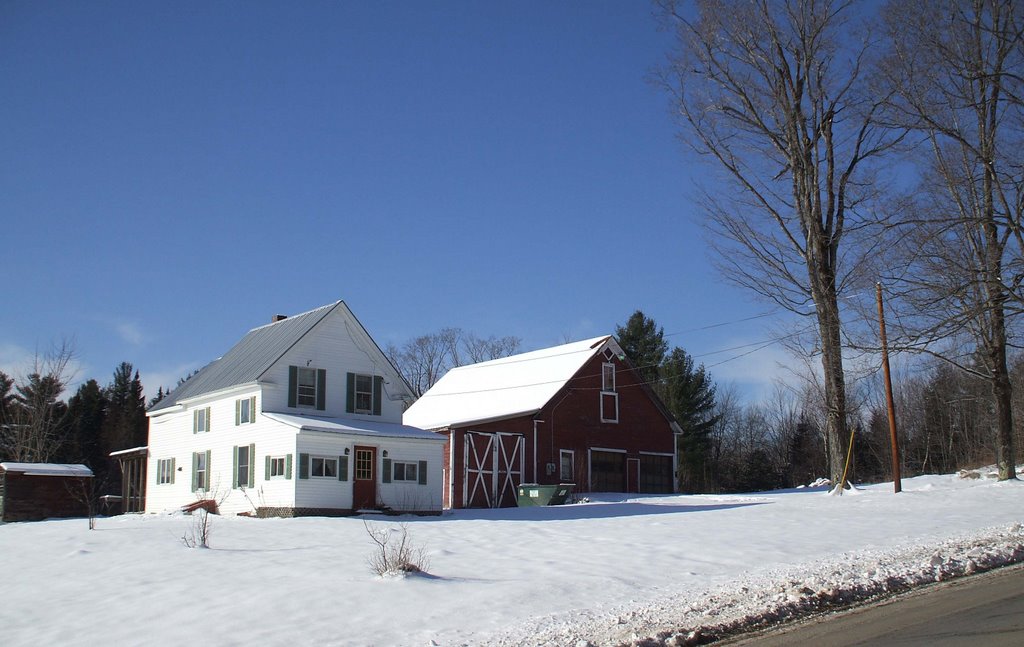
This picturesque little snow-covered homestead is, in fact, my new home. The weather at the start of the week was horrifically cold, but the natives acknowledged as much, so I'm not too shocked, and that is how you get such beautiful blue skies. And it was wonderful today -- cold and crisp but not bone-chilling.

The house is about 4 miles from the office and quiet, though cars sometimes pass by. If the road weren't at all busy, I'd have to worry about being snowed in, but it has just enough traffic to be a priority and it gets cleared quickly and well. I've got a neighbor across the road, though you have to look sharply to see his house, even with no leaves on the trees, and another in back, but at quite a distance. I don't know they're around unless I want to.

The house has three bedrooms upstairs, and a large livingroom, generous kitchen and closet of a bathroom downstairs. My friend Terry, who I discovered quite by serendipity was living here, figures it's a century or more old. I'm quite sure he's right.

Terry is someone I've known for nearly 40 years. We met in the 1968-69 academic year, when I was a sophomore and he was working construction and playing music in the various coffeehouses on and off-campus. We even lived together briefly in the fall of 1970, but then I dropped out of school and moved to Colorado.

I ran into him again when I was moving back east in 1987 -- I stopped off at my old college as we drove through Indiana and ran into Terry, who happened to be visiting from Maine. It was quite a surprise reunion. We then saw each other on purpose in 1989 twice, again at a musicians' reunion in Indiana in 1994 and at a second reunion concert there in 2005. At that last meeting, he told me he was living in some little town in Maine -- a different town than in the 80s -- but it didn't mean anything to me at the time.

When I got this job, they sent me a few copies of the paper so I could get a handle on it, and I saw a letter to the editor Terry had written. Turns out he lives about 10 miles from here. This meant I had someone to run me around and help me find a place to live, and also to help unpack the truck. (A task shared by me, Terry, my son Gabe and my new boss, David.)

The job is good. In fact, it's a lot of fun and the people at the paper are all good folks who like working with each other. The work is more time-critical than at my last job, in the sense that, while there isn't more of it, there are people specifically waiting for various tasks to be completed, so I can't necessarily put off one thing while I work on something else, which I could back when I was a one-man band and the final deadline was all that mattered.

The trade-off is that I'm not working without a net anymore -- there are people to help troubleshoot the work as it's being done, and to pick up some of the pieces when I'm starting to flail. I like that.

I'm still living out of boxes, and without TV or Internet at home -- posting this from the office -- but I'm busy enough that it isn't too big a deal. I plan to do some unpacking this weekend, explore the area a little and then go over to Terry's to watch some football on Sunday.

Life is good here on the farm.

Saturday, January 06, 2007


Some Immigrants Just Never Stop Immigrating

Here's a column I wrote at my old job seven years ago, but which seems applicable today. The picture is of my son, Gabe, and my dog, Mr. O'Malley, on a bluff overlooking the Mississippi on yet another move from Colorado to New York, in 1987.

The way I heard the story, my great-grandfather Pedersen was sailing into Copenhagen when he realized he'd made a mistake. Others in the family say he already knew he was only coming back to say good-bye.

In any case, he and his brothers had gone to America with a plan to earn money and buy farms back in Denmark. They worked around the country at about anything they could put their hands to and, somewhere along the line, he gave up the part about coming home again.

He wound up on the Upper Peninsula of Michigan, among a lot of other Scandinavians and some Cornishmen, too, who had come to the iron mines to make new lives for themselves. He never got rich, but he lived long enough to see his son head off to Wisconsin for college and then, later, move to Pennsylvania as manager of an iron mine there.

I'm sure it never occurred to him to tell his son not to move away. After all, it was how he had found his own place in the world. That seems to be what we built in this country: A family tradition in which you define yourself by who you are, not where you are.

My mother's family tree is full of people who were born with itchy feet, and who passed them on to their children. Great-great-great grandfather Leander Phoenix came from Quebec to Saratoga Springs, married a Broadalbin girl and then took her away to the midwest, where they produced a son, Josiah, who, as an adult, used to take long walks every Sunday, visiting a different church, sampling a different religion, each week. Just to see what it was like.

Another great-great-great grandfather on that side of the family came from Cork via London, then worked a farm in northern Indiana, where he helped the local priest build the first building of what would, 125 years later,
be my university. He moved on to
Clinton, Iowa, and later out to Boone. Family tradition says he finally found a place to stay, not because it was perfect, but because that was where the horses died.

In short, we arrived as immigrants and never stopped moving. Some brothers and sisters along the way stuck a peg in and stayed put, but those in my direct line, my parents, grandparents and various degrees of greats, never did. Except for a few transitional periods, I don't think we ever had two adult generations living in the same place on this side of the Atlantic, and my own siblings are now in Colorado, Florida, New York, West Virginia and suburban DC, none closer than 300 miles to another.

It is, however, a willingness, rather than an eagerness, to move. That is a distinction often lost on those with an instinct to stay put.

When my father was about the age I am now, he'd already moved once, from Pennsylvania to New York, where he had built a solid career in the mining business and raised a family in an idyllic little town where people cared for each other.

But the company had become enmeshed in what was then a brand-new phenomenon, the leveraged buyout, and the new owners had started cannibalizing it to maximize profits and pay off the cost of acquisition. Decisions made, not by steel people in Pittsburgh, but by money people on Wall Street, were about to kill the mines, and the town that relied upon them. My father did not fancy presiding over this cold-blooded, miserable process.

For all the arrogance of a 20-year-old, I knew when to listen with respect, as we walked around the lake one spring day and my father poured out his frustrations and unhappiness. But when, a few months later, my little brother, his youngest son, was killed in an accident at 17, I challenged him.

"Tony never got a chance to do the things he really wanted to do with his life," I said to him. "When are you going to do the things you really want to do?"

A few months later, he called to tell me he'd found a job that combined his experience on the school board with his years of industrial management, as labor negotiator for the Kenmore School District. The change from life in
Star Lake to life in Buffalo was wrenching, but the price of staying in one place had been exacting a far greater toll.

It was time to move on, and so he moved on, and it was a good move. He finished out the last 10 years of his career doing something he wanted to do, something he truly enjoyed, something he could feel good about doing.

For all the wonderful, generous things my father did for us, I was never so proud of him as I was when he accepted the legacy of a family that has never let a well-established life and the fear and inconvenience of change
keep them from living the lives they must live.

Now my own adult children, speaking from their homes in New York, in Massachusetts and in Connecticut, have accepted the role I took before them, that of nagging their father into exchanging comfort for disruption,
into overturning his life for the better, into doing what he truly needs to be doing.

So this will be my last column for the Press-Republican, as I end 12 happy years in Plattsburgh, and set out for the next place.

Thanks for everything. Maybe we'll run into each other again, somewhere down the road.

Copyright 1999, Press-Republican, Plattsburgh NY