Saturday, September 30, 2006


What did the president say and how did he say it?

Darrin Bell's "Candorville" is one of the bright spots on the comics page -- smart, funny commentary that has a distinctly progressive point of view but never shrinks from self-criticism.

But he doesn't stop there, and he runs a meeting place called ToonTalk where cartoonists gather for both professional and political exchanges.

And he has a blog at candorville.com which recently linked to this very revealing 11 minute excerpt of the now-infamous Clinton interview on Faux News. Why infamous? Because they took a segment that ran just under a minute out of context and used it to concoct a smear. Here's a little more, and it's a great performance by Clinton.

Do you have 11 minutes to watch this? Well, what's 11 minutes compared to the past six years and the next two years? You've got 11 minutes.

Wednesday, September 27, 2006


This week in "Drawing Conclusions," we look at the compromise between the White House and GOP senators on questioning suspected terrorists, through the eyes and pens of Bill Schorr and Kevin Siers.

Meanwhile, Nellie Bly visits Thailand to report on a coup in which a Thai general uses an unusual but fascinating metaphor for what he and his co-conspirators have done.

Comments are always welcome.

Saturday, September 23, 2006


I think you lost them at "if" ...

(From a NYTimes article about NBC contemplating airing a concert in which Madonna mimicks the Crucifixion with herself the victim.)

Madonna also issued a statement on Thursday saying that the performance was “neither anti-Christian, sacrilegious or blasphemous.”

“Rather,” it went on to say, “it is my plea to the audience to encourage mankind to help one another and see the world as a unified whole. I believe in my heart that if Jesus were alive today, he would be doing the same thing.”

(picture: Madonna confers with Jesus at a popular watering hole.)

Wednesday, September 20, 2006


And so it's come to this ...

My friend Mike Powers is a musician, a magician and a mathematician. We go back nearly 40 years, and do so every once in awhile by assembling some old reprobates for music and fellowship. It didn't make me feel old when he retired from teaching (math) and started concentrating on his magic -- he started teaching as soon as he graduated, so it's okay that he piled up enough years to retire.

But in an email, he writes: BTW – I’m playing in a rock band. It’s a blast. Our website is www.blackjack66.com. As you might surmise, our name is Blackjack 66. It’s difficult getting gigs these days. These blasted DJ’s don’t cost much and people seem to prefer just listening to their favorite tunes. We go over well at VFWs and places with an older crowd that likes to dance. It’s really fun to rock the joint and get everyone dancing.

Consarn it, it's a helluva thing when old rock-and-rollers have to go down to the danged VFW post and play for the old folks to get people who will rock out with them. We used to be the people our parents warned us about. Now we're just our parents.

On the other hand, I've got music from the band's website playing as I write this, and it ain't too bad. Y'know ... for a bunch of old guys ... (actually, it looks suspiciously like the band only includes ONE old guy ... )

Tuesday, September 19, 2006


This week in Drawing Conclusions, two cartoonists -- Jim Morin and Jeff Danziger -- take different artistic tacks to the same purpose: Commenting on the way the White House has responded to GOP criticism of its attempts to re-focus Article 3 of the Geneva Convention.

Meanwhile, Nellie Bly goes to Budapest, where what may have been an out-of-context quote from a taped party meeting has sent rioters into the streets.

http://www.nelliebly.org

Feedback is always welcome!

Sunday, September 17, 2006


Howard (if that's his name) Eats

Well, about a week after taking up residence here, and I suspect a week after taking up residence anywhere outside an egg, the turtle has eaten. This isn't unusual -- they subsist for a week or two on yolk. But yesterday he snapped at some turtle food and since then has eaten a few pieces, which, for someone his size, is probably enough. I'm always surprised at how rarely reptiles eat, but I suppose if you aren't burning a lot of energy regulating your blood temperature, that makes sense.

I'd try to post a movie of him eating but one of the things I learned in reading about these animals is that they need a place to hide. So I gave him a piece of broken earthenware and now I have the thrill of a pot of water on my kitchen counter with occasionally a foot or the tip of a tail in sight or, on good days, a glimpse of his head. This is not very much like owning a dog.

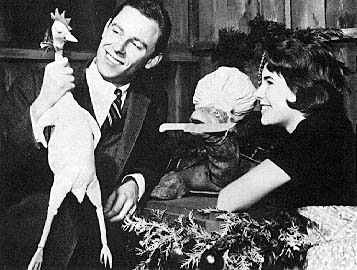
Ronnie asks if he has a name and he doesn't appear to, but if he did, it would be Howard. That's Howard the Turtle, between Al Hamel and Michelle Finney. They starred on a fondly remembered CBC kids show called Razzle Dazzle. I've mentioned it to Canadians in the past with no particular response, and when I looked it up, I found out why. It was only on the air for about four years and you'd have to be at least 45 to remember it, and 10 years older to have been in its target age.

However, in looking it up, I realized why my friend Chris Morphy and I were so in love with Michelle. All these years, I've assumed she was a young-looking young woman. No, she was our age -- she was 11 the first year the show was on, 12 the second year, and replaced the third year, at which point we quit watching it anyway because we were high school freshmen and had other things we needed to be doing.

The show was a mix of things, including Howard, who was a sock puppet sticking out of a turtle body on a pedestal. The puppeteer who did Howard also did the puppets for The Friendly Giant and Mr. Dressup, so you have to think Burr Tilstrom rather than Jim Henson.

They showed serials, mostly "The Terrible Ten" which was Australian and since we didn't get to see the show every day, a little confusing -- mostly kids with funny accents running around. And they read viewer mail, and had a segment where they would choose an invention from a viewer and make it. Chris had one that got on the air, a kind of sombrero with a poncho rolled up on the brim so that, if it rained, you could just pull it down. They made it, Michelle modelled it and Chris was supposed to get the prototype in the mail, though I don't know if he ever did. I know it didn't show up right away.

Howard would dress up, as in this picture, or he would come up with some wonderful idea that wouldn't work, or a combination of the two. The only one I remember specifically was the time he bought an island that was going to make him wealthy because it produced so many potatoes. It was called "Potato-Eating Island" but on the map he was given, they just used the initials.

This would have been one of the more sophisticated jokes on Razzle Dazzle. Michelle would groan and say, "That's a real groaner!" but she loved Howard and I think that's why we loved Michelle. She was just what every seventh grade boy wants: A really cute girl who likes really stupid jokes. (Viewers also sent in groaners. The show was very well targeted to our age group.)

I couldn't find any information on whatever happened to Michelle Finney. A few years after Razzle Dazzle went off the air, she had a role in a CBC drama in which she played a young pioneer, and she was competent without blowing everyone out of the water. And I found evidence of a reunion show with Al and Howard in 1978, but that was it.

Anyway, this turtle doesn't seem to have a name, but, if he had a name, it would probably be Howard.

Tuesday, September 12, 2006


This week, Drawing Conclusions explores the use of fiction in documenting history, specifically the history of 9/11, through the eyes and pens of Mike Peters and Glenn McCoy.

Meanwhile, Nellie Bly notes Constitution Day with a report on Thomas Jefferson's insistence that an educated, informed public was the best defense against bad government.

http://www.nelliebly.org

Comments, as always, welcome.

Sunday, September 10, 2006


Crikey! This snapping turtle has lightning reaction time and powerful, crushing jaws!

Well, maybe some day. Meanwhile, I'm going to let him hang out in a tank on the kitchen counter through the winter and see how he does. I figure that, by next summer, he'll be about 2/3 the size of a hockey puck and will have gotten to the point where I'd have to invest in real equipment and start to worry about those jaws.

Fortunately, since these guys genuinely operate on a reptilian brain and nothing else, you can't really do much to interfere with their survival instincts. If I put him in a pond where the things that move are edible, he'll be fine. And snapping turtles also eat things that haven't moved in several days. They're not finicky. I also have a pretty good sense of the odds of a hatchling making it through the first week, never mind the first year of life. I don't think I'm going to be significantly messing with his fate.

A number of years ago -- that number being 21 -- I had a girlfriend with a pet snapping turtle named Roland who was about the size of your hand, as long as you were careful and kept him away from your hand. Otherwise, he would be somewhat larger than your hand.

Roland lived in a tank by her back kitchen door, in about three inches of water and gravel. She'd buy feeder goldfish and put them in his water, where they would swim around what appeared to be a large rock. Then there would be a splash but you wouldn't actually see his head move. What you would see was goldfish scales floating in the water and a bit of fishtail hanging out of Roland's mouth.

When it was time to clean his tank, I would hold Roland up between finger and thumb at the very back of his shell while she rinsed out the tank. He would occasionally crane his neck around to see what was holding him and I would marvel at the length and flexibility of that neck, just as I would marvel at his reaction speed when he was fed. Not a comforting combination, and considering that Roland never gave the slightest inclination that he even knew who we were, much less any sense of being nice to the source of his food, I really couldn't see the point. I'm curious to see how this little fellow grows and behaves, but I doubt I'll feel bad about releasing him when the time comes.

Incidentally, in researching the proper care of snapper hatchlings, I found a very detailed web site by someone who really understands reptiles, with specifications about the type of filter and the various light bulbs and calcium supplements and so forth. It was starting to look like it would cost more to keep a turtle than a dog.

Then I found another web site by a woman who apparently keeps turtles in tanks throughout her house. She was a lot more laid back about the process. Roland lived in about the opposite of all the conditions the expert laid out, but it sounded quite a bit like the conditions she discussed.

We're going with the second option.

Friday, September 08, 2006


Just as funny as it was four years ago. However, I have an uncomfortable feeling that, more and more often these days, this conversation takes place in editorial board meetings.

(Foxtrot, by Bill Amends)

Tuesday, September 05, 2006


This week, Nellie Bly marks five years of reporting with a few anecdotes and a link to a "Best of Nellie Bly" page, featuring a half dozen of her most memorable stories.

Meanwhile, in "Drawing Conclusions," Jim Morin and Ben Sargent take Labor Day as an opportunity to examine the current state of the working class.

http://www.nelliebly.org

Monday, September 04, 2006


Neville Chamberlain in Iraq

(Mother Jones republished Frank Rich's column despite it being part of the NYTimes Select stuff you're supposed to pay for! Shame on them! Here's the column -- judge for yourself how naughty Mother Jones was!)

September 3, 2006
Op-Ed Columnist
Donald Rumsfeld’s Dance With the Nazis
By FRANK RICH

PRESIDENT BUSH came to Washington vowing to be a uniter, not a divider. Well, you win some and you lose some. But there is one member of his administration who has not broken that promise: Donald Rumsfeld. With indefatigable brio, he has long since united Democrats, Republicans, generals and civilians alike in calling for his scalp.

Last week the man who gave us “stuff happens” and “you go to war with the Army you have” outdid himself. In an instantly infamous address to the American Legion, he likened critics of the Iraq debacle to those who “ridiculed or ignored” the rise of the Nazis in the 1930’s and tried to appease Hitler. Such Americans, he said, suffer from a “moral or intellectual confusion” and fail to recognize the “new type of fascism” represented by terrorists. Presumably he was not only describing the usual array of “Defeatocrats” but also the first President Bush, who had already been implicitly tarred as an appeaser by Tony Snow last month for failing to knock out Saddam in 1991.

What made Mr. Rumsfeld’s speech noteworthy wasn’t its toxic effort to impugn the patriotism of administration critics by conflating dissent on Iraq with cut-and-run surrender and incipient treason. That’s old news. No, what made Mr. Rumsfeld’s performance special was the preview it offered of the ambitious propaganda campaign planned between now and Election Day. An on-the-ropes White House plans to stop at nothing when rewriting its record of defeat (not to be confused with defeatism) in a war that has now lasted longer than America’s fight against the actual Nazis in World War II.

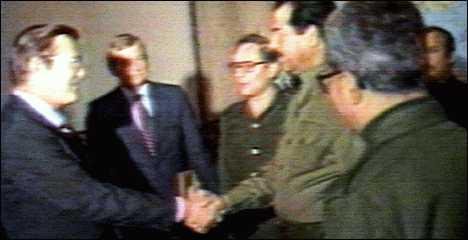
Here’s how brazen Mr. Rumsfeld was when he invoked Hitler’s appeasers to score his cheap points: Since Hitler was photographed warmly shaking Neville Chamberlain’s hand at Munich in 1938, the only image that comes close to matching it in epochal obsequiousness is the December 1983 photograph of Mr. Rumsfeld himself in Baghdad, warmly shaking the hand of Saddam Hussein in full fascist regalia. Is the defense secretary so self-deluded that he thought no one would remember a picture so easily Googled on the Web? Or worse, is he just too shameless to care?

Mr. Rumsfeld didn’t go to Baghdad in 1983 to tour the museum. Then a private citizen, he had been dispatched as an emissary by the Reagan administration, which sought to align itself with Iraq in the Iran-Iraq war. Saddam was already a notorious thug. Well before Mr. Rumsfeld’s trip, Amnesty International had reported the dictator’s use of torture — “beating, burning, sexual abuse and the infliction of electric shocks” — on hundreds of political prisoners. Dozens more had been summarily executed or had “disappeared.” American intelligence agencies knew that Saddam had used chemical weapons to gas both Iraqi Kurds and Iranians.

According to declassified State Department memos detailing Mr. Rumsfeld’s Baghdad meetings, the American visitor never raised the subject of these crimes with his host. (Mr. Rumsfeld has since claimed otherwise, but that is not supported by the documents, which can be viewed online at George Washington University’s National Security Archive.) Within a year of his visit, the American mission was accomplished: Iraq and the United States resumed diplomatic relations for the first time since Iraq had severed them in 1967 in protest of American backing of Israel in the Six-Day War.

In his speech last week, Mr. Rumsfeld paraphrased Winston Churchill: Appeasing tyrants is “a bit like feeding a crocodile, hoping it would eat you last.” He can quote Churchill all he wants, but if he wants to self-righteously use that argument to smear others, the record shows that Mr. Rumsfeld cozied up to the crocodile of Baghdad as smarmily as anyone. To borrow the defense secretary’s own formulation, he suffers from moral confusion about Saddam.

Mr. Rumsfeld also suffers from intellectual confusion about terrorism. He might not have appeased Al Qaeda but he certainly enabled it. Like Chamberlain, he didn’t recognize the severity of the looming threat until it was too late. Had he done so, maybe his boss would not have blown off intelligence about imminent Qaeda attacks while on siesta in Crawford.

For further proof, read the address Mr. Rumsfeld gave to Pentagon workers on Sept. 10, 2001 — a policy manifesto he regarded as sufficiently important, James Bamford reminds us in his book “A Pretext to War,” that it was disseminated to the press. “The topic today is an adversary that poses a threat, a serious threat, to the security of the United States of America” is how the defense secretary began. He then went on to explain that this adversary “crushes new ideas” with “brutal consistency” and “disrupts the defense of the United States.” It is a foe “more subtle and implacable” than the former Soviet Union, he continued, stronger and larger and “closer to home” than “the last decrepit dictators of the world.”

And who might this ominous enemy be? Of that, Mr. Rumsfeld was as certain as he would later be about troop strength in Iraq: “the Pentagon bureaucracy.” In love with the sound of his own voice, he blathered on for almost 4,000 words while Mohamed Atta and the 18 other hijackers fanned out to American airports.

Three months later, Mr. Rumsfeld would still be asleep at the switch, as his war command refused to heed the urgent request by American officers on the ground for the additional troops needed to capture Osama bin Laden when he was cornered in Tora Bora. What would follow in Iraq was also more Chamberlain than Churchill. By failing to secure and rebuild the country after the invasion, he created a terrorist haven where none had been before.

That last story is seeping out in ever more incriminating detail, thanks to well-sourced chronicles like “Fiasco,” “Cobra II” and “Blood Money,” T. Christian Miller’s new account of the billions of dollars squandered and stolen in Iraq reconstruction. Still, Americans have notoriously short memories. The White House hopes that by Election Day it can induce amnesia about its failures in the Middle East as deftly as Mr. Rumsfeld (with an assist from John Mark Karr) helped upstage first-anniversary remembrances of Katrina.

One obstacle is that White House allies, not just Democrats, are sounding the alarm about Iraq. In recent weeks, prominent conservatives, some still war supporters and some not, have steadily broached the dread word Vietnam: Chuck Hagel, William F. Buckley Jr. and the columnists Rich Lowry and Max Boot. A George Will column critical of the war so rattled the White House that it had a flunky release a public 2,400-word response notable for its incoherence.

If even some conservatives are making accurate analogies between Vietnam and Iraq, one way for the administration to drown them out is to step up false historical analogies of its own, like Mr. Rumsfeld’s. In the past the administration has been big on comparisons between Iraq and the American Revolution — the defense secretary once likened “the snows of Valley Forge” to “the sandstorms of central Iraq” — but lately the White House vogue has been for “Islamo-fascism,” which it sees as another rhetorical means to retrofit Iraq to the more salable template of World War II.

“Islamo-fascism” certainly sounds more impressive than such tired buzzwords as “Plan for Victory” or “Stay the Course.” And it serves as a handy substitute for “As the Iraqis stand up, we’ll stand down.” That slogan had to be retired abruptly last month after The New York Times reported that violence in Baghdad has statistically increased rather than decreased as American troops handed over responsibilities to Iraqis. Yet the term “Islamo-fascists,” like the bygone “evildoers,” is less telling as a description of the enemy than as a window into the administration’s continued confusion about exactly who the enemy is. As the writer Katha Pollitt asks in The Nation, “Who are the ‘Islamo-fascists’ in Saudi Arabia — the current regime or its religious-fanatical opponents?”

Next up is the parade of presidential speeches culminating in what The Washington Post describes as “a whirlwind tour of the Sept. 11 attack sites”: All Fascism All the Time. In his opening salvo, delivered on Thursday to the same American Legion convention that cheered Mr. Rumsfeld, Mr. Bush worked in the Nazis and Communists and compared battles in Iraq to Omaha Beach and Guadalcanal. He once more interchanged the terrorists who struck the World Trade Center with car bombers in Baghdad, calling them all part of the same epic “ideological struggle of the 21st century.” One more drop in the polls, and he may yet rebrand this mess War of the Worlds.

“Iraq is not overwhelmed by foreign terrorists,” said the congressman John Murtha in succinct rebuttal to the president’s speech. “It is overwhelmed by Iraqis fighting Iraqis.” And with Americans caught in the middle. If we owe anything to those who died on 9/11, it is that we not forget how the administration diverted our blood and treasure from the battle against bin Laden and other stateless Islamic terrorists, fascist or whatever, to this quagmire in a country that did not attack us on 9/11. The number of American dead in Iraq — now more than 2,600 — is inexorably approaching the death toll of that Tuesday morning five years ago.

Thursday, August 31, 2006


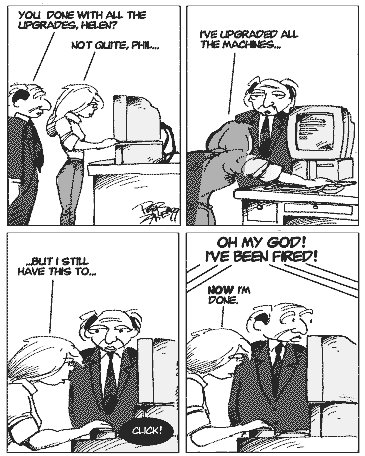
I'm sure this will get plenty of play, but I wanted to point out that yesterday's "Helen, Sweetheart of the Internet" joke is tomorrow's news story.

FORT WORTH, Texas Aug 30, 2006 (AP)
— RadioShack Corp. followed through on its announced plans to cut about 400 jobs, but the electronics retailer has been forced on the defensive about its method of notifying laid-off employees by e-mail.

Employees at the Fort Worth headquarters received an e-mail Tuesday morning telling them they were being dismissed immediately.

"The work force reduction notification is currently in progress," the notice stated. "Unfortunately your position is one that has been eliminated."

Wednesday, August 30, 2006


Wit from the Bench

I was researching Supreme Court cases regarding the rights of students for an upcoming series on the Constitution when I came across this excerpt from an opinion written by Justice Stevens in the 1981 case of Widmar v. Vincent. In that case, the court ruled that the University of Missouri was wrong to ban the use of campus facilities by religious groups, saying that while the university had the right to set rules, they couldn't single out religion as a banned content area. In his concurring opinion, Stevens sought to emphasize that requiring fairness was not a requirement that schools give up any attempt at critical judgment:

Because every university's resources are limited, an educational institution must routinely make decisions concerning the use of the time and space that is available for extracurricular activities. In my judgment, it is both necessary and appropriate for those decisions to evaluate the content of a proposed student activity.

I should think it obvious, for example, that, if two groups of 25 students requested the use of a room at a particular time -- one to view Mickey Mouse cartoons and the other to rehearse an amateur performance of Hamlet -- the First Amendment would not require that the room be reserved for the group that submitted its application first.

Nor do I see why a university should have to establish a "compelling state interest" to defend its decision to permit one group to use the facility and not the other. In my opinion, a university should be allowed to decide for itself whether a program that illuminates the genius of Walt Disney should be given precedence over one that may duplicate material adequately covered in the classroom.

Tuesday, August 29, 2006


Drawing Conclusions goes light on the politics this week with a look at Pluto's demotion through the eyes of the Toronto Star's Dave "Andy" Anderson and the Detroit News's Henry Payne.

Meanwhile, Nellie Bly takes the anniversary of Katrina as an occasion to do a little reflecting on how tight deadlines and bogus numbers intersect in the news business.

http://www.nelliebly.org

Sunday, August 27, 2006


Bogus pop-up of the day

Yeah, I think I saw these girls the last time I drove through Fort Edward.
They had the spreader loaded and they were headed for the hayfield.
(Yes, I sometimes lie about my exact location when registering.)

Saturday, August 26, 2006


NYTimes exclusive: Water is a drowning hazard! (and math is hard!)

HONOLULU, Aug. 25 — The blue waters surrounding the Hawaiian Islands may be irresistible, to tourists and residents alike, but swimming there — or surfing, snorkeling, diving or kayaking — can be deadly. And not just for the reason that seizes the imagination.

What? The reason that seizes my imagination is that the ocean has a pretty high water content, not to mention rip tides and such.

While it is the infrequent shark attacks that make the headlines, (Oh, right. Jaws. Okay, carry on.) drowning claims far more lives in Hawaii, where coastlines of sand, coral reef and lava rock create shorebreaks and currents that cause many swimmers to encounter peril entirely unexpected. Indeed, most of the victims are adults who thought they were good swimmers.

(Okay, I can live with "many," though "entirely unexpected" gives me a slight case of the collywobbles. But could we get a source for that last statistic -- drowning rates among adults who self-rated their swimming ability as "good"?)

“The waters at many beaches are deceptively beautiful,” said Dr. Chiyome Fukino, the state health director. “Even if you know how to swim, if you get into nasty surf, if you’re ill or injured, your chances of drowning are increased.”

Seventy-one people drowned in Hawaii in 2004, 58 of them in the ocean. The toll was the highest here in 15 years, but then was eclipsed by last year’s total of 77.

It is not just the millions of tourists who are at risk. Nearly half of all drowning victims are residents, a statistic that gives Hawaii an exceptionally high per-capita rate. The state’s Department of Health reports that from 1999 to 2003, 9.7 people drowned for every 100,000 residents, more than double the national rate of 4.7. That made the state’s rate for the period second only to that of Alaska, where fishing accidents account for a large share of drownings.

Let's go back to the "half of them are residents" part. Is she saying that the 9.7 per 100,000 stat is based only on dead residents? If so, why doesn't it say "9.7 Hawaiians drowned ... "

A look at Hawaii's Dept of Health suggests that she's counting the tourists despite having just excluded them. I couldn't find the exact figures she's citing (and I do have to get back to work on my paying job), but here's what a quick search turned up:

G. Drowning Deaths

Current status and trends in Hawai`i

Drownings are the second leading cause of unintentional injury death. Each year in Hawai`i, there are nearly 50 drownings and over 100 water-related hospitalizations occurring mainly from activities in the ocean and pools. Hawai`i has more ocean-related drownings and injuries leading to death and disability per square mile than any other state. Nearly half of all ocean-related drownings and hospitalized injuries occur to non-residents, therefore de facto population estimates yield a more accurate injury rate.

Healthy Hawai`i 2000
Objective Baseline (1990)47 and current data

9.H Reduce drowning deaths to Drowning deaths 1990 1991 1992 1993 1994
no more than 3.0 per 100,000 among state residents 4.4 2.5 3.2 3.4 3.4
people. Drowning deaths 5.3 3.6 3.8 4.3 5.3
inde facto population

NOTE: Hawai`i's baseline for this objective is not resident population-based, as it includes visitors. Therefore, it can not be compared to the national objective.
47Hawai`i Department of Health Status Monitoring, Vital Statistics data, special tabulation.

She goes on to talk about the videos they're showing tourists to warn them about the dangers of the ocean -- pretty much recycling a story that ran two months ago in the Honolulu Advertiser, but not ripping it off. Just not improving on it much. The difference being that the Advertiser ran some fact boxes that, while more current than the ten-year-old figures in this DOH report, were closer to this rate than the 9.7 quoted by the NYTimes writer.

And the Honolulu reporter didn't automatically assume that, when readers think of hazards in the ocean, they imagine Jaws.

Tuesday, August 22, 2006


This job description is a lot funnier if you understand journalism pay scales

Company: Democrat and Chronicle
Position:
Business reporter
Location:
Rochester, New York
Job Status: Full-time
Salary: Not Specified
Ad Expires:
September 22, 2006
Job ID: 672529
Description:
We’re seeking an enterprising business reporter to cover fast-developing medical tech and biotech industry, including Bausch & Lomb, one of the world's largest eye-care companies. The reporter will think new media, eager to break news on our website and bring a flair for good writing to Page 1A and the Sunday and daily Business sections of our newspaper (160,290 daily and 219,660 Sunday). On the multimedia front, this reporter should be prepared to do podcasts, collect audio interviews, work with videographers and appear on television with the local ABC affiliate as needed. Interested? Please contact Neill Borowski, managing editor, the Democrat and Chronicle, Rochester, NY. Email jobs@democratandchronicle.com and nborowsk@democratandchronicle.com.

(cartoon is Between Friends by Sandra Bell-Lundy)

Friday, August 18, 2006


Here we go again.

School is just around the corner and I've got mountains of stuff to get done in the next two weeks. This year's serial combines mythology and astronomy and, unfortunately, I don't really know much about astronomy except what I learned in Earth Science ... well, so long ago that some of the stars have moved since then. I'm way out of my comfort zone with this stuff, but it will be pretty cool when I'm done. (Fortunately, I have the help of a friend. Unfortunately, he's out of the country.)

Which either means I won't be updating the blog much or else I'll be posting a lot, and so, by checking in here, you'll be able to tell whether I'm hunkered down or blissfully avoiding what must be done.

The illustration here is a favorite Peanuts simply because so many NIE programs base their entire educational approach on goofy fun stuff of no real value in the classroom. A classic request on the NIE listserv is "Does anyone have the directions for making a pressman's hat?" While I have nothing against making hats, I wish that request was at least equalled, if not outnumbered by, "Does anyone have any really good First Amendment resources?"

In any case, I'll be in the office much of the weekend and I won't be folding hats.

Sunday, August 13, 2006


No pida, no diga

(an Ecuadorian pamphlet my co-worker, Peggy, came across. A translation I cobbled from Babelfish.)

Thursday, August 10, 2006


Arthur Lee died the other day. That won't matter to very many people, but it will certainly be noticed by those who knew who he was.

About ... gee ... was it 20 years ago? More or less. Anyway, I was at a college reunion and my buddy Charlie came by, even though it wasn't his year, and we played a little guitar music together. We played "Signed DC" and "A House Is Not A Motel" and then were piddling around with a kind of funny one called "Live and Let Live."

I mentioned that, since I'd left school, I hadn't run into very many people who had even heard of Love, much less knew any of their songs. And Charlie off-handedly remarked, "Well, they were a musicians' band." And I realized it was true -- the people who I associated with the group were almost all musicians, or very close to the music scene.

The thing that was different with Love was that a lot of the bands that are "musicians' bands" are so esoteric that nobody would want to listen to them except to marvel over (and steal) certain licks. But Love was incredibly listenable music, with nice, accessible instrumentation (easier to listen to than to play) and a kind of baroque lyrical sense that Jim Morrison could have learned from. And apparently did.

Funny thing: One of the obits I read quoted a line from "The Red Telephone" as an example of Arthur Lee's genius. The line -- "They're locking them up today. They're throwing away the key. I wonder who it will be tomorrow, you or me? (We're all normal and we want our freedom!)" -- was often quoted back then. But the line was taken from "Marat/Sade." (The lyrics linked here attribute the song to Bryan Maclean, but it's by Lee. Except, y'know, for the line everybody quotes.)

And speaking of locking people up and throwing away the key, for awhile back in those days, I lived next door to a guy who was on a "perma-trip." Steve had dropped acid one time and never really came down again. It had been awhile and, though he was from Washington, DC, he was in South Bend at the moment because his buddies took turns watching out for him, and a couple of them were living out there. He wasn't at all trippy or goofy -- actually, he was very quiet and very nice, but you couldn't really hold a conversation with him. I don't think he was hallucinating. He'd just completely lost his ability to focus. He'd get various shelf-stocking sorts of jobs but he couldn't hold it together and he'd just kind of not work, and either he'd get fired or he'd stop showing up.

But one thing he could still do was play guitar, and he could play every song Love recorded, really well. He was a human jukebox, and there are several Love songs that still remind me of Steve, sitting up in his room playing. He went back to DC after a couple of months and I have no idea what happened to him. I kind of hope someone a little more grounded than his buddies eventually took over his care and feeding.

For that matter, I wish someone more grounded had been able to take over Arthur Lee's care and feeding, because he certainly put himself through some unnecessary things. One of those obits where you're sorry he's dead, but you're also kind of surprised he was still alive.

Anyway, lots of memories and associations, some sublime, some ridiculous. I don't know why this band wasn't more popular. But if you read the obit linked to Lee's name at the beginning, you'll see that a lot of later-to-be-popular bands were listening to him.